




Risk Management in Retaining Walls and Excavations in Camboriú
Geological complexity and the financial impact on construction sites
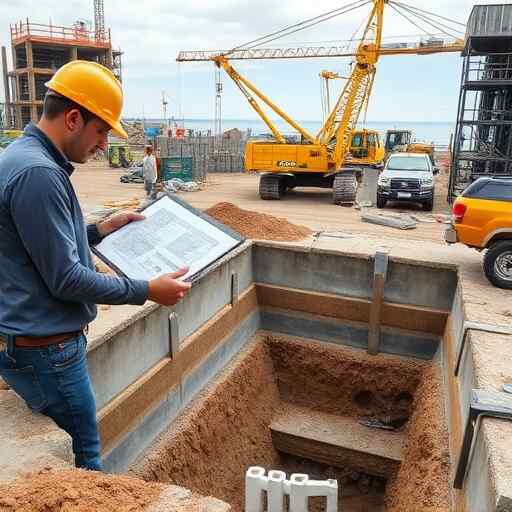
Executing excavations and retaining systems in Camboriú requires a deep understanding of the region’s geotechnical characteristics. The local soil, often composed of landfill layers, colluvium, and the proximity of the water table, imposes significant technical challenges. When an excavation begins without an in-depth study or rigorous planning, the risk of differential settlement in neighboring buildings becomes imminent. For WGB Architecture and Engineering, the financial loss lies not only in the cost of a poorly sized retaining structure but also in indemnities for third-party damages, judicial work stoppages, and the irreversible damage to the construction company’s reputation in the luxury market.
Rigorous cost control begins with the sounding phase (SPT/CPT), which must be used as the basic input for technical modeling. Ignoring soil variability is the root cause of structural collapses. A retaining system designed based on assumptions rather than real geological data results in material waste, such as oversized steel profiles or, conversely, catastrophic failures due to undersizing. Precision engineering requires that every dollar invested in planning exponentially reduces the cost of unforeseen contingencies.
BIM methodology as a risk mitigation tool
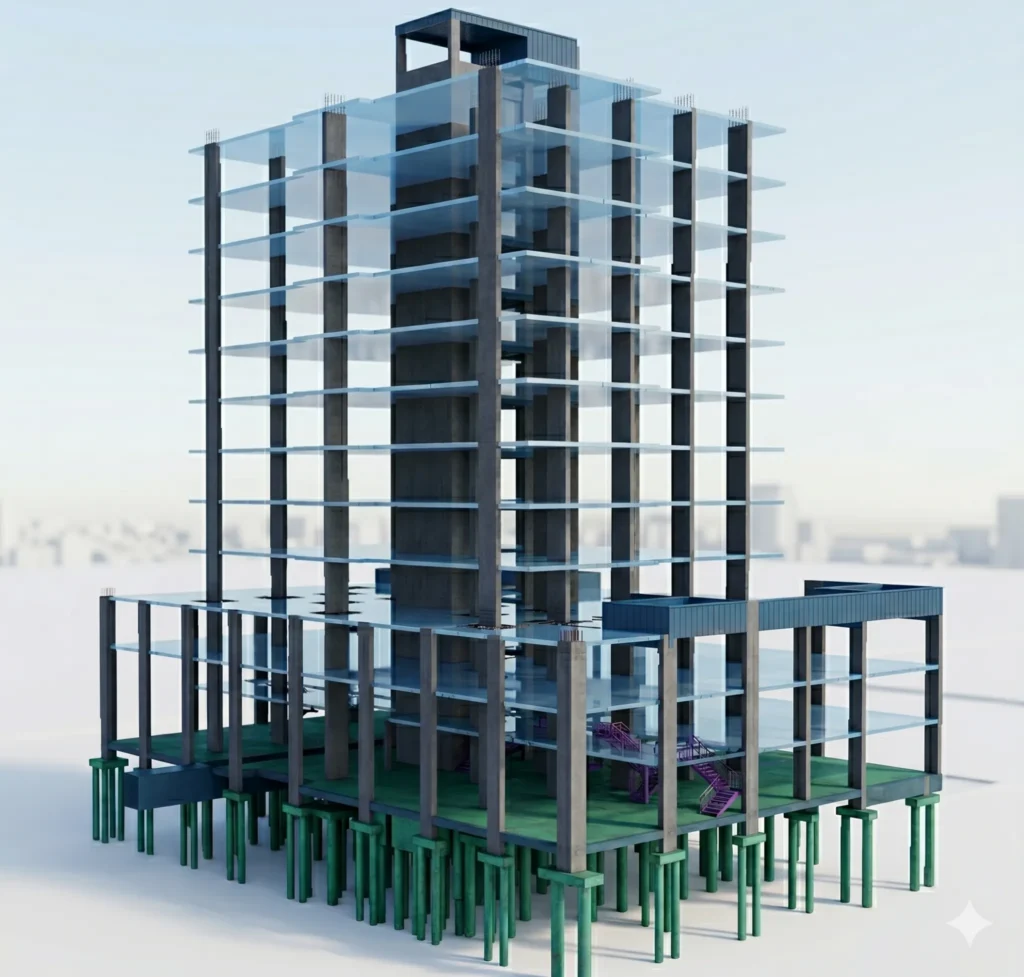
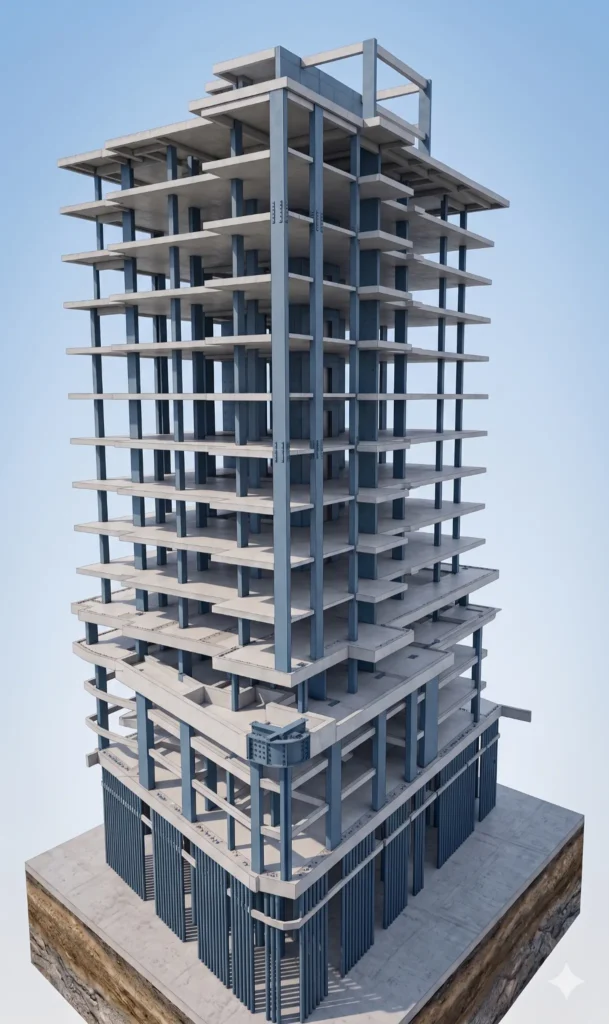
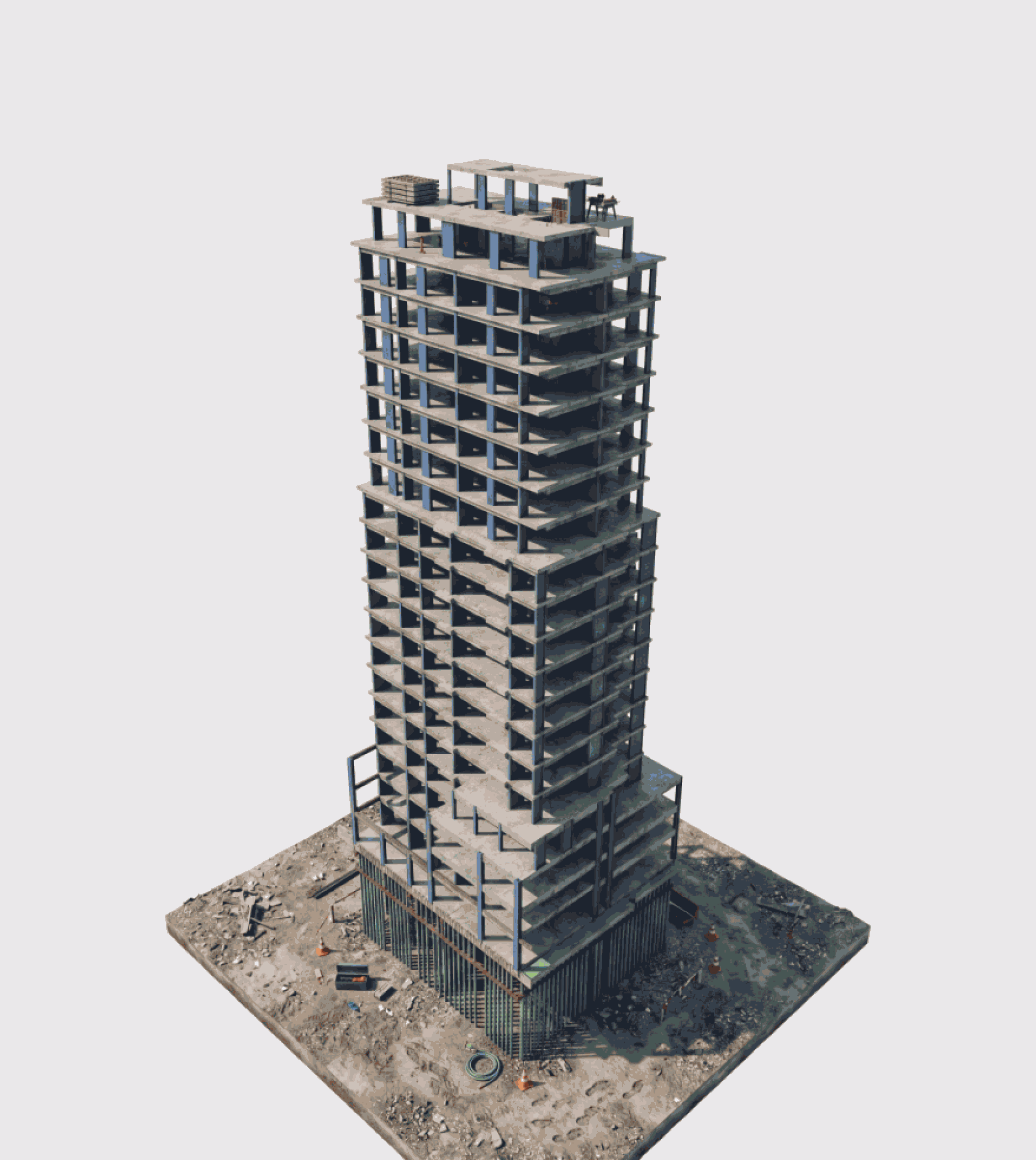
Building Information Modeling (BIM) has transformed the way we manage complex construction projects. In excavations, BIM 4D (time) and 5D (cost) modeling allow for the exact simulation of each stage of earthmoving and the installation of retaining elements, such as sheet piles, diaphragm walls, or tangential pile curtains. By inserting the digital model into a coordination environment, we can detect spatial interferences between the new building’s foundations and the retaining structure before the first excavator even reaches the site.
The use of BIM for cost control allows for the automatic and precise quantification of required materials. By extracting the volumes of soil to be removed, the volume of shotcrete, and the total length of anchored tie-backs, WGB eliminates budgetary uncertainties. Furthermore, the centralized model serves as a basis for real-time monitoring of construction progress. If a deviation is detected during excavation near Morro do Careca, for example, the model is quickly updated to recalculate structural and financial impacts, allowing the management team to make decisions based on technical data rather than operational intuition.
Preventive inspection and legal protection for developers
A neighbor inspection (pre-construction survey) is the most effective legal and technical tool to avoid financial losses in construction projects in dense urban areas. In compliance with Brazilian Standard NBR 12722, which establishes procedures for quality control and technical responsibility, the inspection must be carried out thoroughly before any earth movement. This document is not just a formality, but a technical report that describes the state of conservation of all surrounding properties, with photographic records of cracks, fissures, and pre-existing pathologies.
By conducting a preventive inspection with WGB’s rigor, we isolate the construction company’s liability regarding pre-existing damages. This avoids costly lawsuits filed by neighbors attempting to attribute old pathologies to the new excavation. The detailed record, signed by experts and corroborated by the Neighbor Inspection Report, acts as insurance against bad-faith litigation. In cities with the real estate dynamism of Camboriú, where proximity between structures is the rule, this practice is the foundation for responsible and financially sustainable risk management.
Rigorous cost control and value engineering
Managing costs in retaining systems means managing uncertainties. The instability of excavation faces is a risk that can be priced through automated geotechnical monitoring. Sensors installed on neighboring structures and the retaining wall itself monitor displacements in millimeters. If an alert limit is reached, corrective actions are taken immediately. This is far cheaper than remediating a complete collapse, which would involve a total shutdown, emergency structural reinforcements, and contractual fines. Value engineering works to select the retaining technique that offers the best balance between geotechnical safety and cost-benefit.
Many companies fail by trying to save on the design and execution of retaining structures. The use of low-quality materials, poor drainage execution, or the lack of properly tested tie-backs are errors that eat into the project’s net profit. At WGB, we apply value analysis methodologies that compare different execution scenarios. Through our expertise, we evaluate, for example, whether a pile curtain is more advantageous than soil nailing stabilization for a specific rock profile, considering not only labor but the overall construction schedule.
Earthmoving operations and site management
The logistics of a construction project in Camboriú involve managing intense truck flows and site organization. Soil accumulation near the edge of an excavation creates unforeseen surcharges on stability calculations, which can cause the collapse of pit walls. An experienced project manager must ensure that the site layout respects the soil’s allowable loads and foundation influence lines. Rigorous planning of each stage, from mobilization to foundation completion, is what ensures the project stays on track according to the financial schedule.
Maintaining operational quality in high-density construction environments is a daily exercise in coordination. Each day of delay resulting from retaining issues generates fixed costs, personnel expenses, equipment rental, and, primarily, the opportunity cost of idle capital. WGB Architecture and Engineering understands that technical excellence is the best way to protect the client’s assets. We combine the use of cutting-edge technologies, such as laser scanning to check the plumb of retaining walls, with constant field execution monitoring, ensuring that what was modeled in BIM is faithfully reproduced in the physical reality.
Conclusion: The value of technical precision
The modern civil construction market does not tolerate amateurism, especially in cities experiencing rapid and continuous growth. The complexity of the terrain demands an evidence-based approach, where technology and technical experience unite to mitigate risks and maximize return on investment. Prevention, through structured planning, is the only path to ensuring your project is not just a concrete structure, but a secure and valued financial asset. WGB is ready to raise the bar for construction and ensure total safety by performing the neighbor inspection in Camboriú, mitigating liabilities and ensuring the absolute integrity of your assets.