
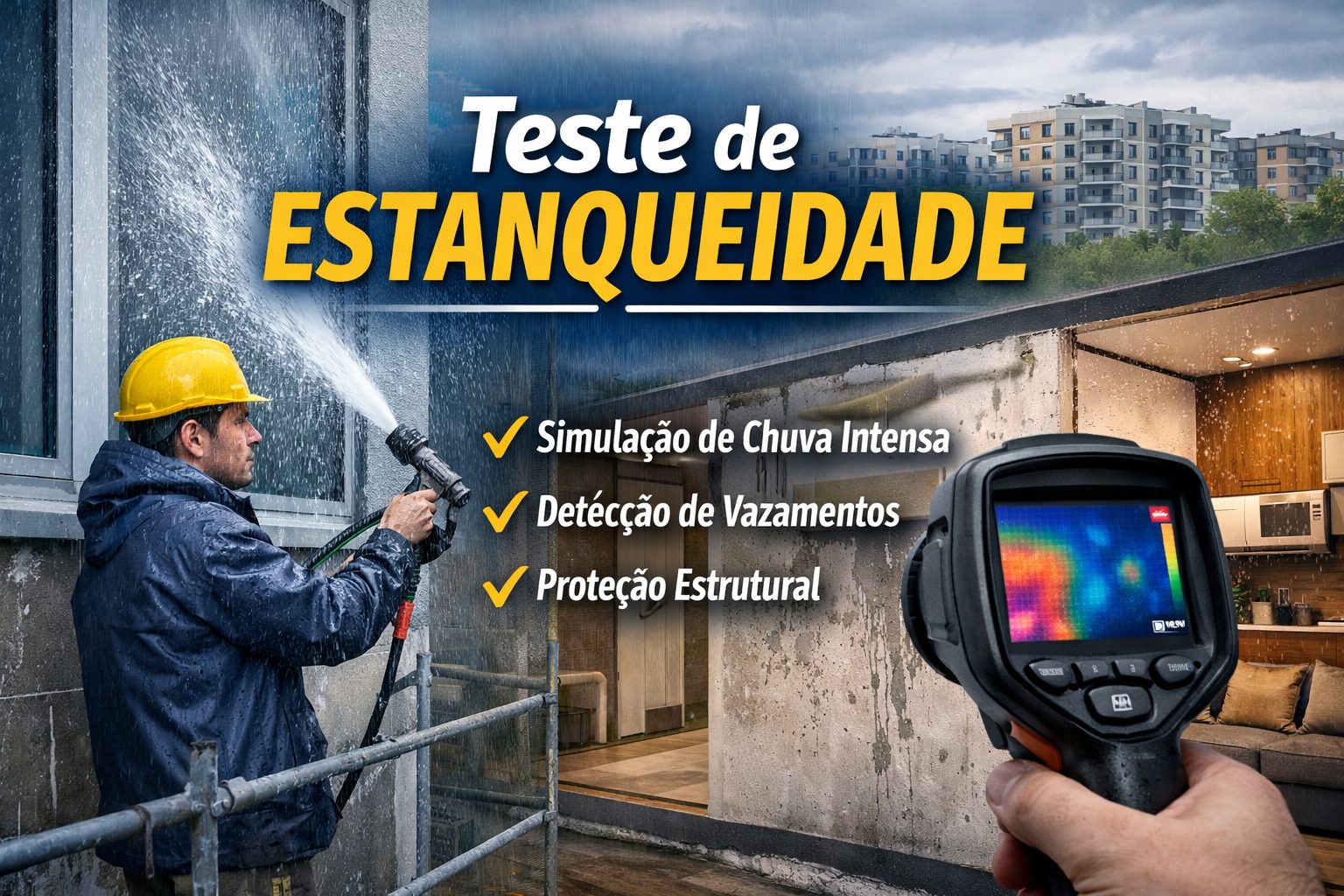
















Do you know what a leak test is? In general, Most owners only come into contact with this term when a problem arises. In these situations, Unexpected leaks, seepage in walls, or even water appearing inside the structure may occur.
In practice, However, many buildings are still delivered without proper leak testing. This happens because, In many cases, there is no effective verification of whether the building actually prevents water from entering. As a direct consequence, However, problems arise months or even years later, when the correction becomes complex and financially burdensome.
Throughout this article, In this course, you will understand what a leak test is, why it is essential, how it is performed, what technical standards regulate it, and, in addition, what to do when a building fails the test. At the end, It will become clear why no building should be handed over without a watertightness certificate.
What is a Leak Test?
The watertightness test is a technical test that verifies whether the building's structure prevents water from entering through walls, slabs, seals, and connections. I.e, This is an objective verification of the building's performance against the action of water.
The term comes from Latin: "estanca," which means to prevent passage. Therefore, A watertight building is one that does not allow leaks.
Formal Definition
According to NBR 15.575 (Performance in Residential Buildings), the watertightness test consists of verifying the building's ability to reject water ingress by simulating rainfall under controlled conditions. Like this, The test is not random, but standardized.
How it Works in a Simple Way
Consider, for example, an apartment building facade. In that case, The procedure involves:
- Thoroughly wet the facade, simulating heavy rain.
- Next, check for water entering through drains, cracks, or openings.
- If there is no infiltration, the test is approved.
- However, if any water enters, the test fails and corrections are required.
Why is Leak Testing Important?
Although many consider the test merely a formality, in reality, It is one of the most important tests for the durability of the building.
1. Prevents Future Leaks
Without testing, leaks can appear after 1 or 2 years. As a result, arise:
- Damage to the walls, such as mold and efflorescence.
- Structural damage due to corrosion of the reinforcement bars.
- Repair costs between R$ 10,000 and R$ 50,000 per unit
In contrast, Performing the test before delivery costs between R$ 2,000 and R$ 5,000.
Real risk: Water infiltration that permanently compromises the structure.
2. Ensures compliance with technical standards.
Brazilian standard NBR 15.575 requires that residential buildings meet watertightness requirements. That way, Without the certificate, the project may face difficulties in:
- Obtaining real estate financing
- Sell units
- Approve future inspections
Consequently, legal and commercial problems arise.
3. Reduces Health Problems
Excessive moisture promotes the growth of harmful agents. Among them, Among the highlights are:
- Mold, associated with respiratory allergies.
- Mites, which thrive in humid environments.
- Fungi, especially dangerous for people with low immunity.
Like this, A watertight building directly contributes to a healthier environment.
4. Protects Facilities and Structure
When water reaches inappropriate locations, various systems are affected. For example, Damage may occur in:
- Electrical installations, increasing the risk of fire.
- Concrete structures, accelerating the corrosion of steel.
- Photovoltaic systems
- Thermal and acoustic insulation
Therefore, The risk goes beyond mere discomfort.
5. Increases the Building's Lifespan
A building that is well protected against leaks can have a lifespan of between 50 and 70 years. On the other hand, Buildings with recurring sealing failures may require severe structural repairs in just 30 to 40 years.
Consequently, premature depreciation of the property occurs.
How Leak Testing Works in Practice
The test follows technical procedures defined by specific standards. Like this, The process is divided into well-defined stages.
Phase 1: Preparation
Before the test, it is necessary that:
- All the finishing touches are complete.
- Drains are installed.
- Doors and windows should be properly adjusted.
- The weather conditions are suitable.
Normally, This phase takes 1 to 2 days.
Phase 2: Equipment Positioning
At this stage:
- Pressure hoses are positioned in the areas to be tested.
- In addition, thermal cameras can be installed indoors.
- Meanwhile, technicians remain on standby.
In this context, Correct positioning is crucial for identifying even the smallest flaws.
Phase 3: Rain Simulation
The area being tested receives water under controlled pressure. In general, the following are used:
- Typical flow rate of 50 liters/minute per linear meter.
- Duration between 15 and 30 minutes
Like this, A severe rain and wind condition is simulated.
Phase 4: Internal Monitoring
While water is applied externally, simultaneously, Technicians are inspecting the interior of the property. At that time, it is verified:
- Any sign of water ingress
- Droplet formation
- Thermal changes detected by infrared camera
Therefore, Any infiltration indicates a failure.
Phase 5: Technical Report
After the rehearsal:
- ✅ If approved, a report and certificate will be issued.
- ❌ Otherwise, a report will be presented with the exact points of failure.
Conclusion
In summary, the leak test is an indispensable technical requirement to guarantee the safety, durability, and performance of the building.
Therefore, to carry out this essay:
- It prevents leaks and high costs.
- Ensures regulatory compliance.
- It protects the health of residents.
- Extends the lifespan of the building.
- It facilitates the sale of the property.
Like this, Requiring and conducting the test is not optional. It is a technically, strategically, and economically sound decision.