

















Innovation and efficiency are essential for industrial growth. In civil construction, the BIM project Building Information Modeling (BIM) is a major advancement. It uses a BIM technology Advanced technology to change how we view and manage buildings and infrastructure.
BIM started in the US in the 1970s. Since then, it has changed CAD and brought about... virtual construction To another level. Now, he creates three-dimensional digital models with important information for the entire project, from planning to completion.
In Brazil, the BIM project It is growing rapidly. This positions the country as an important market for innovation and optimization in virtual construction.
What is BIM and why is it important in the construction industry?
BIM (Building Information Modeling) is more than just a technology or software. It's a methodology that changes how projects are done. civil engineering. He uses elements of digital project to make the creation, visualization, management and execution of constructions more efficient and economical.
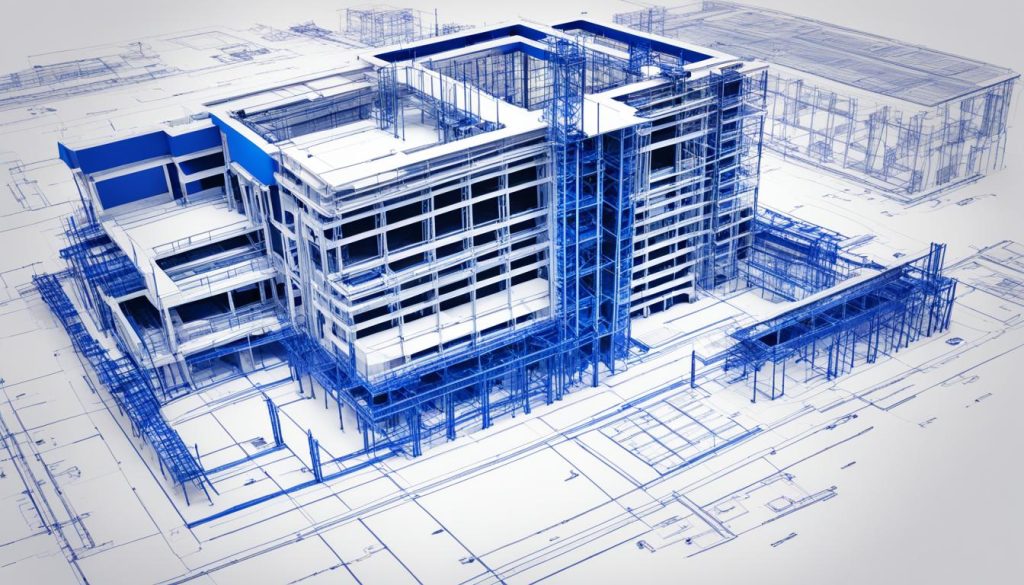
A intelligent architecture BIM unites different disciplines and dimensions. This brings important benefits:
- It allows you to see the future building in 3D and make adjustments before construction begins.
- It simulates construction phases, costs, and schedules, improving project predictability.
- It provides a detailed analysis of energy, acoustics, and other environmental performance simulations.
- Identify project interferences or conflicts early, reducing delays and costs.
In practice, BIM changes the way buildings are designed, constructed, and maintained. civil engineering. It offers a complete and detailed view of projects. This makes BIM an essential tool for modernization and efficiency in... digital projects in civil construction.
Applications and benefits of BIM design
Using BIM (Building Information Modeling) methodology in civil construction projects brings many benefits. It improves how projects are designed and managed. 3D modeling and project collaboration are key to greater efficiency and sustainability.
- Team IntegrationBIM helps to improve collaboration on projects. It unites the various areas involved from the beginning to the completion of the project. This ensures that everyone understands the project equally and in an up-to-date manner.
- Resource OptimizationWith the 3D modeling, It's possible to identify problems before construction begins. This helps avoid rework and reduce expenses, lowering costs.
- Predictability of Timelines and CostsBIM allows you to simulate construction and view costs in real time. This improves forecasting and helps make adjustments before construction begins, improving financial control.
- SustainabilityDetailed modeling helps analyze environmental impact and use materials more efficiently. This supports sustainable construction.
BIM is also a tool for thoroughly documenting all project details. This improves communication and information sharing among all stakeholders.
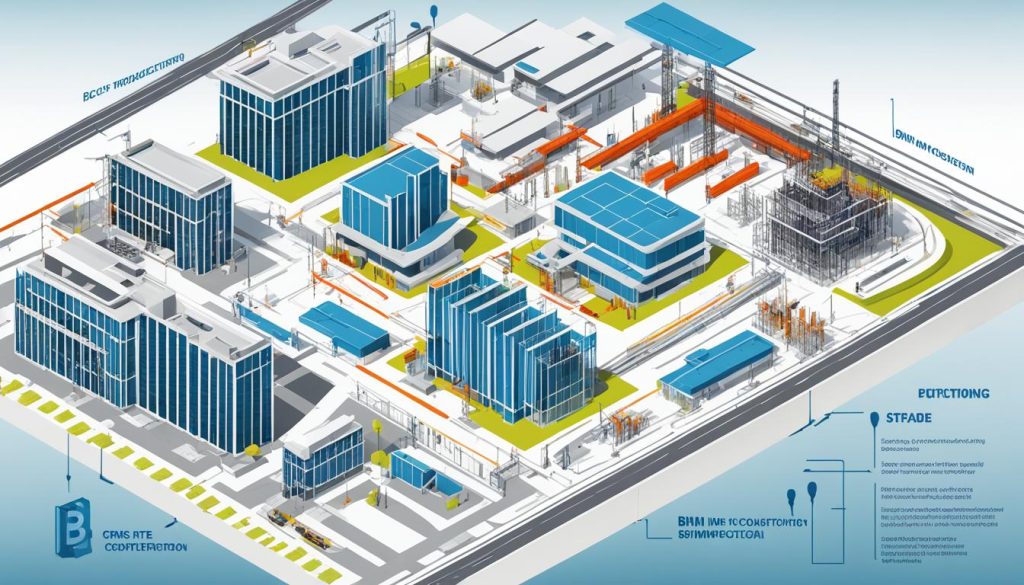
The implementation of the BIM project in Brazil
In Brazil, BIM began to be used more widely in 2010. This marked the beginning of a new era of innovation in civil construction. In 2018, the Brazilian government created the National BIM Dissemination Strategy. This decree aimed to regulate and promote the use of BIM throughout the country.
Despite advancements, BIM still faces challenges. These include training professionals, purchasing software, and changing company mindsets. However, over time, these barriers are being overcome. The market is seeing the benefits, such as lower costs and greater efficiency.
- Strengthening regulations and standardizing the use of BIM.
- Government incentives for training professionals specialized in BIM.
- Adopting BIM as a standard in public infrastructure projects, also encouraging the private sector.
The implementation of BIM is bringing about a revolution in the Brazilian construction industry. Although there are challenges, the potential for change is great. With more companies adopting these tools, Brazil is becoming a leader in innovation in Latin America.
The Digital Revolution: Intertwining BIM design and technology
The BIM project has changed the construction industry for the better. It uses software such as Revit, Navisworks, and Archicad. This makes projects more precise and efficient.
- A interoperability It makes the software programs communicate well with each other. This improves the accuracy of the projects.
- Revit It's great for detailed modeling. With Navisworks, This makes projects easier to manage and simulate. This keeps the project safe and viable.
- Archicad It is easy to use and has powerful tools for drawing and documentation.
These BIM tools make construction faster and more economical. They also allow for analysis and adaptations at all stages of the project. With the integration of these platforms, projects become clearer and more sustainable.
Collaboration in projects with BIM: Multidisciplinary Teams
In the BIM era, professionals from various fields, such as engineers, architects, and builders, work together. They are part of a highly integrated and innovative environment. This helps to make better decisions in projects and constructions.
With BIM, collaboration between architects, engineers, and builders changes. Now, they exchange up-to-date and accurate information all the time. This provides a complete view of the project, ensuring that everyone is aligned with the objectives.
- Error reduction: With real-time information, there are fewer differences between what was planned and what actually happened.
- Resource optimization: With all the data shared, it's possible to make better use of resources, avoiding waste.
- Integration of steps: From planning to execution, all phases of the project are integrated. This makes management and execution easier.
With BIM, engineers, architects, and builders share knowledge and skills. This improves not only efficiency but also the final quality of projects.
Virtual construction and 3D electronic models
To the electronic mock-ups are essential in virtual construction. They allow you to view complex projects in 3D before construction begins. With BIM, these models clearly show details and structures.
This greatly helps in the development and execution of construction projects.
- With the 3D visualization, Professionals understand the project better. They can see it from different angles and perspectives.
- To the electronic mock-ups They allow you to simulate situations. For example, seeing how the light changes with the seasons. This helps to analyze better before finalizing the project.
- In virtual construction, It's easy to make adjustments and revisions. This saves money and makes better use of resources.
- This technology also identifies problems beforehand, thus preventing rework and mismatches in construction.
To the electronic mock-ups These tools are becoming increasingly important in architectural planning. They bring innovation and improvements to construction. Using these tools improves the quality of projects and makes technology more accessible.
BIM Project: From theory to practice in civil works
Implementing BIM in civil engineering is a major step forward for the construction industry. It transforms theory into something real and tangible. This improves accuracy and efficiency, and also provides teams with more information about the project.
See how this works technically and practically:
- A BIM implementation It begins with information modeling. This includes design, quantities, and construction quality.
- In the field, BIM helps to visualize the project clearly. This allows for adjustments before construction, preventing errors and extra costs.
- BIM supports the concept of As Built. It records details of the constructed building. This is important for future maintenance and management.
Understanding BIM isn't easy and requires knowledge of Levels of Detail (LODs). LODs help to detail the project. Here's how they work:
- LOD 100 – It shows the basic idea of the project. It's good for initial studies.
- LOD 200 – Adds geometric elements. Useful for cost analysis and estimation.
- LOD 300 – Provide more details, allowing for authorizations and coordination.
- LOD 400 – It details even further, preparing for construction.
- LOD 500 – Shows details of what has been installed. This is important for maintenance and operation.
By understanding LODs (Levels of Detail), teams can better prepare. This makes the transition from theory to practice in civil engineering projects easier, ensuring the project is executed as planned.
Improvements with BIM: Process automation in construction.
Building Information Modeling (BIM) is changing the construction industry. It not only improves accuracy with 3D models, but also automates and integrates processes. This helps professionals be more innovative and reduce errors in projects.
With BIM, efficiency increases significantly. Calculations are performed quickly and accurately. This makes budgets more detailed and reliable. Professionals can focus on important tasks, improving project quality and construction management.
BIM is changing the future of construction. It improves the quality of projects and prepares for a future with more automation. With it, constructions are more efficient and sustainable. BIM is an essential tool for the construction industry.