

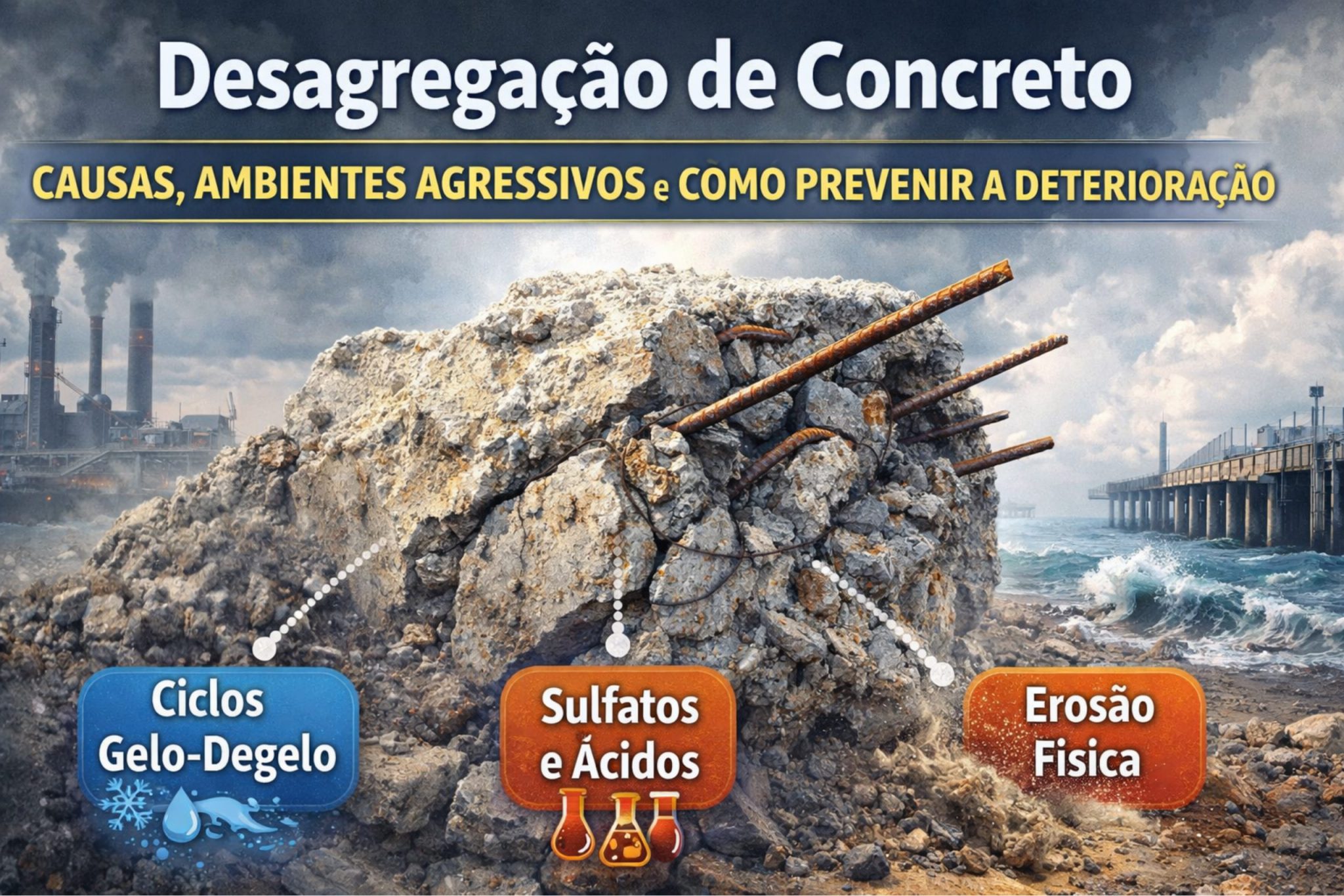

The disintegration of concrete represents the Progressive loss of cohesion of the cementitious matrix., leading, over time, to structural disintegration. In practical terms, This process affects approximately 40 to 50% of the structures located in marine or industrial environments after 20 to 30 years of exposure.
Given this, Understanding its mechanisms, such as freeze-thaw cycles, chemical attacks by sulfates and acids, as well as physical erosion, becomes essential for proper structural design.
Furthermore, This is a silent pathology that develops internally until the concrete surface crumbles into dust or detached layers.
In this context, This technical guide presents the main mechanisms of disaggregation, identifies critical aggressive environments, describes preventive strategies from the design stage and details structural repair techniques.
Disaggregation vs. Displacement: Critical Differences
Disintegration (Internal Deterioration)
Initially, In this case, disintegration occurs due to the direct action of aggressive agents on the cementitious matrix.
Aggressive agents penetrate the concrete ↓ React with the cementitious matrix ↓ Destroy the cohesion between particles ↓ Material becomes brittle and permeable ↓ Progressive loss of strength
As a consequence, It can be observed:
- Infecting the internal matrix of concrete
- Imperceptible evolution in the initial stages.
- Reduction of compressive strength between 30 and 70%
- Deterioration is widespread, not localized.
Detachment (Detachment of the Coating)
On the other hand, The spalling is directly associated with corrosion of the reinforcement.
Corrosion of the reinforcement → expansion ↓ Internal pressure in the concrete cover ↓ Surface detachment ↓ Exposure of the reinforcement
Therefore, while the Detachment is a consequence of corrosion., a Disintegration is a primary and independent cause of deterioration..
Cause 1: Freeze-Thaw Cycles (Cold Environments)
Statistically, this mechanism is responsible for 30 to 40% of cases in regions with cold climates.
Physical Mechanism
Firstly, This causes the water present in the pores to freeze.
Liquid water in the pores ↓ Temperature below 0°C ↓ Ice formation ↓ Volumetric expansion of 9%
Right away, High internal pressures develop:
Pressure generated: 25–300 MPa Concrete tensile strength: 3–5 MPa Result: internal cracking
Consequently, Even high-strength concrete can break.
Water-Ice Diffusion
About that, In smaller pores, water is expelled, while larger pores accumulate ice.
Small pores → negative pressure. Capillary pores → ice growth. Result → progressive increase in pressure.
Like this, Deterioration tends to begin on the exposed surface.
Effect of Repeated Cycles
In the course of time, The repetition of these cycles intensifies the damage.
1–10 cycles: microscopic damage; 50–100 cycles: visible disintegration; 200+ cycles: structural failure.
Influence of Concrete Quality
Comparatively:
- Well-specified concrete: slow and controlled damage.
- Porous concrete: accelerated deterioration
In that regard, The incorporated air reduces the damage by approximately 80%.
Prevention with Built-in Air
Embedded air: 4–6% A/C ratio ≤ 0.45 fck ≥ 30 MPa
That way, This creates space to absorb the expansion of the ice.
Cause 2: Sulfate Attack (Marine and Industrial Environments)
In turn, sulfate attack accounts for 50 to 60% of cases of disintegration in these environments.
Sulfates + cement paste ↓ Ettringite formation ↓ Volumetric expansion 2–3x
As a result, Internal cracks and loss of cohesion occur.
Types of Attack
- Generalized: slow evolution
- Range of variation: deterioration until 10 times faster
Logo, Structures in the intertidal zone are the most critical.
Preventive Strategies
Cement with low C₃A content, Water/Cement ratio ≤ 0.45, Silica fume (10%), Protective coating
Like this, This drastically reduces sulfate penetration.
Cause 3: Acid Attack (Industrial Environments)
Additionally, Industrial environments present a high risk of acid attack.
Acids neutralize alkalinity; pH drops from 12 to <6; total loss of cohesion.
Therefore, Concrete becomes structurally unviable within a few years.
Cause 4: Erosion and Abrasion (Physical Action)
Finally, The mechanical action of water with solid particles contributes to their disintegration.
Continuous friction, superficial removal, facilitation of chemical attack.
Consequently, The deterioration accelerates.
Diagnosis of Disintegration
Initially, superficial changes occur.
Later, Cracks and loss of mass occur.
In an advanced stage., the structural resistance drops by more than 50%.
Recovery Techniques
- Mild cases: superficial protection
- Moderate cases: removal + polymer mortar
- Severe cases: complete structural reinforcement.
Like this, The correct choice of technique determines the durability of the repair.
Prevention from the Design Stage
In summary, invest 10–15% more Proper specification prevents expenses. 5 to 10 times larger in the future.
Conclusion: Durability is Strategy
Concrete disintegration is completely avoidable when durability is considered from the design stage.
In fact, Structures that are over 50 years old in harsh environments prove this approach.
Finally, Neglecting this initial step invariably results in high costs and premature loss of structural performance.