

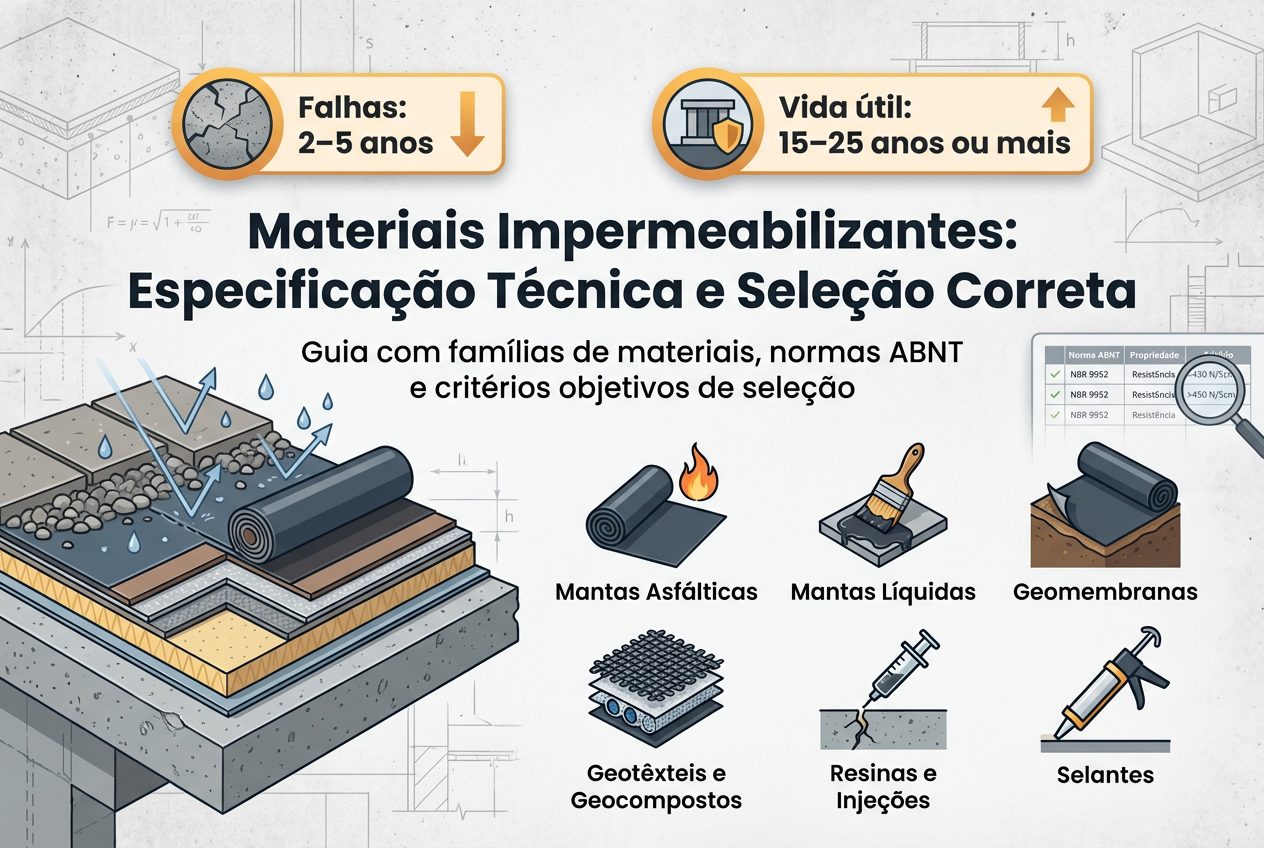
First and foremost, choosing the right waterproofing material is crucial for the system's durability. When this decision is made incorrectly, problems usually arise between 2 and 5 years after application. On the other hand, when the technical specification is thorough, the system can achieve 15 to 25 years or more of service life.
In this context, understanding the properties of each material, its compatibility with the substrate, and, moreover, its environmental exposure is essential for specifying engineers. In other words, the difference between a low-quality membrane and a well-specified solution represents the difference between continuous rework and durable performance.
Therefore, this guide presents the main families of waterproofing materials, their technical properties, ABNT standards, comparative tables, and objective selection criteria.
Main Families of Waterproofing Materials
Currently, there are six main families of waterproofing materials. Each one, therefore, caters to specific applications and different levels of technical requirements.
Family 1: Asphalt Blankets (≈55% from the Market)
ABNT Specification
ABNT NBR 9952 – Asphalt waterproofing membrane
Classification
- Type I: Oxidized asphalt
- Type II: Modified asphalt (SBS or APP)
- Type III: Special use
In addition, blankets are classified by performance.
Technical Properties – Type II Class A
| Property | ABNT requirement | Typical Value |
|---|---|---|
| Longitudinal traction | ≥ 180 N | 400–500 N |
| Transverse traction | ≥ 180 N | 400–450 N |
| Stretching | 25% | 30–35% |
| Water absorption | < 1.5% | < 1.0% |
| Impact | ≥ 2 J | 4.9–6.0 J |
| Flexibility | ≤ −5 °C | ≤ −10 °C |
| Watertightness | ≥ 10 mca | > 25 mca |
| Lifespan | — | 15–20 years old |
Therefore, blankets Class A They are not optional in new construction and critical areas.
SBS vs. APP – Technical Comparison
| Feature | SBS | APP |
|---|---|---|
| Cold flexibility | Excellent (≤ −30 °C) | Good (≤ −15 °C) |
| Heat resistance | < 100 °C | Up to 140 °C |
| Adhesion | Very good | Good |
| Recommended climate | South / Southeast | North / Northeast |
| Cost | Average | Average |
Therefore, the choice of polymer must take into account the climate of the region.
Recommended Thickness
| Thickness | Useful Life | Use | Recommendation |
|---|---|---|---|
| 3–4 mm | 5–7 years | Internal reforms | ❌ Not recommended |
| 8 mm (double) | 15–20 years old | Coverage and critical areas | ✅ Recommended |
Family 2: Liquid Blankets (≈30% from the Market)
Comparison between Types
| Type | Useful Life | Elasticity | Cost (R$/m²) | Indication |
|---|---|---|---|---|
| Acrylic | 10–15 years | Until 200% | 30–50 | Cost-benefit |
| Polyurethane | 15–20 years old | Up to 300% | 60–100 | High performance |
| Polyurea | 20–25 years old | Maximum | 100–150 | Critical works |
| Siloxane | 8–10 years | Low | 20–40 | Maintenance |
Family 3: Geomembranes (≈5%)
| Property | Value |
|---|---|
| Material | HDPE |
| Permeability | < 10⁻¹³ cm/s |
| Lifespan | 50+ years |
| Thickness | 0.8–2.0 mm |
| Cost | 80–200 R$/m² |
Consequently, they are suitable for basements, reservoirs, and industrial projects.
Family 4: Geotextiles and Geocomposites
| Type | Function | Cost (R$/m²) |
|---|---|---|
| Nonwoven geotextile | Filtration / drainage | 5–15 |
| drainage geocomposite | Intense drainage | 20–40 |
| GCL (bentonite) | Capillary barrier | 30–50 |
Family 5: Resins and Injections
Epoxy × Polyurethane
| Feature | Epoxy | PU Injection |
|---|---|---|
| Function | Structural | Seal |
| Elasticity | Low | High |
| Cure | 24 h | 5–30 min |
| Lifespan | 20+ years | 10–15 years |
Good practice: PU to stop water infiltration + epoxy to restore the structure.
Family 6: Sealants
| Type | Useful Life | UV resistance | Indication |
|---|---|---|---|
| Silicone | 15–25 years old | Excellent | External joints |
| PU sealant | 10–15 years | Moderate | Floors and movable joints |
| MS | 20+ years | Excellent | High performance |
Selection Matrix – Material × Application
| Application | Material | Useful Life | Standard |
|---|---|---|---|
| New roof | SBS double asphalt membrane | 15–20 years old | NBR 9952 |
| Area without traffic | Acrylic liquid membrane | 10–15 years | NBR 16747 |
| Critical subsoil | Geomembrane + geocomposite | 30–40 years | GRI GM13 |
| Dry crack | Epoxy injection | 20+ years | NBR 7583 |
| Active infiltration | PU injection | 10–15 years | ASTM F2436 |
Comparative Cost – Quality × Price (500 m²)
| System | Total Cost | Useful Life | Cost/year |
|---|---|---|---|
| Simple blanket | R$ 30.000 | 6 years | R$ 5.000 |
| Double blanket | R$ 50,000 | 18 years old | R$ 2.800 |
| Acrylic | R$ 35.000 | 12 years | R$ 2.900 |
| PU | R$ 45.000 | 18 years old | R$ 2.500 |
| Geomembrane | R$ 75.000 | 35 years | R$ 2.100 |
Conclusion
In short, inadequate waterproofing materials lead to premature failures and costs. 10 times larger in repairs. Therefore, invest 30–50% more In a properly specified system, the payback period is quick.
Therefore, specifying correctly is not a cost.
É responsible, durable, and cost-effective engineering.