
Repairing cracks in concrete structures is not an empirical procedure, but rather an applied science. In the context of reinforced concrete, each crack has a distinct cause, behavior, and structural implication. Therefore, each requires a specific intervention technique. When the method is chosen inappropriately, the failure tends to reappear within a few years, restarting the cycle of corrective maintenance.
In professional practice, it is observed that approximately 70% of repairs fail not due to execution errors, but due to incorrect diagnosis and inadequate choice of technique. Generally, this occurs when the analysis is limited to the visual aspect of the crack, ignoring its origin, stability, and structural influence. For this reason, understanding the correct hierarchy of techniques, from simple solutions to complex structural interventions, is essential to guarantee durability, performance, and safety.
Given this scenario, this technical guide presents repair methodologies according to the type of crack, addressing the execution process, the costs involved, the expected durability, and objective criteria for decision-making.
Hierarchy of Repair Techniques
Before any intervention, diagnosis is the crucial step. Based on this diagnosis, the appropriate technique is defined according to the width of the crack, its stability, and the predominant cause. Therefore, the following hierarchy guides a rational and safe technical decision.
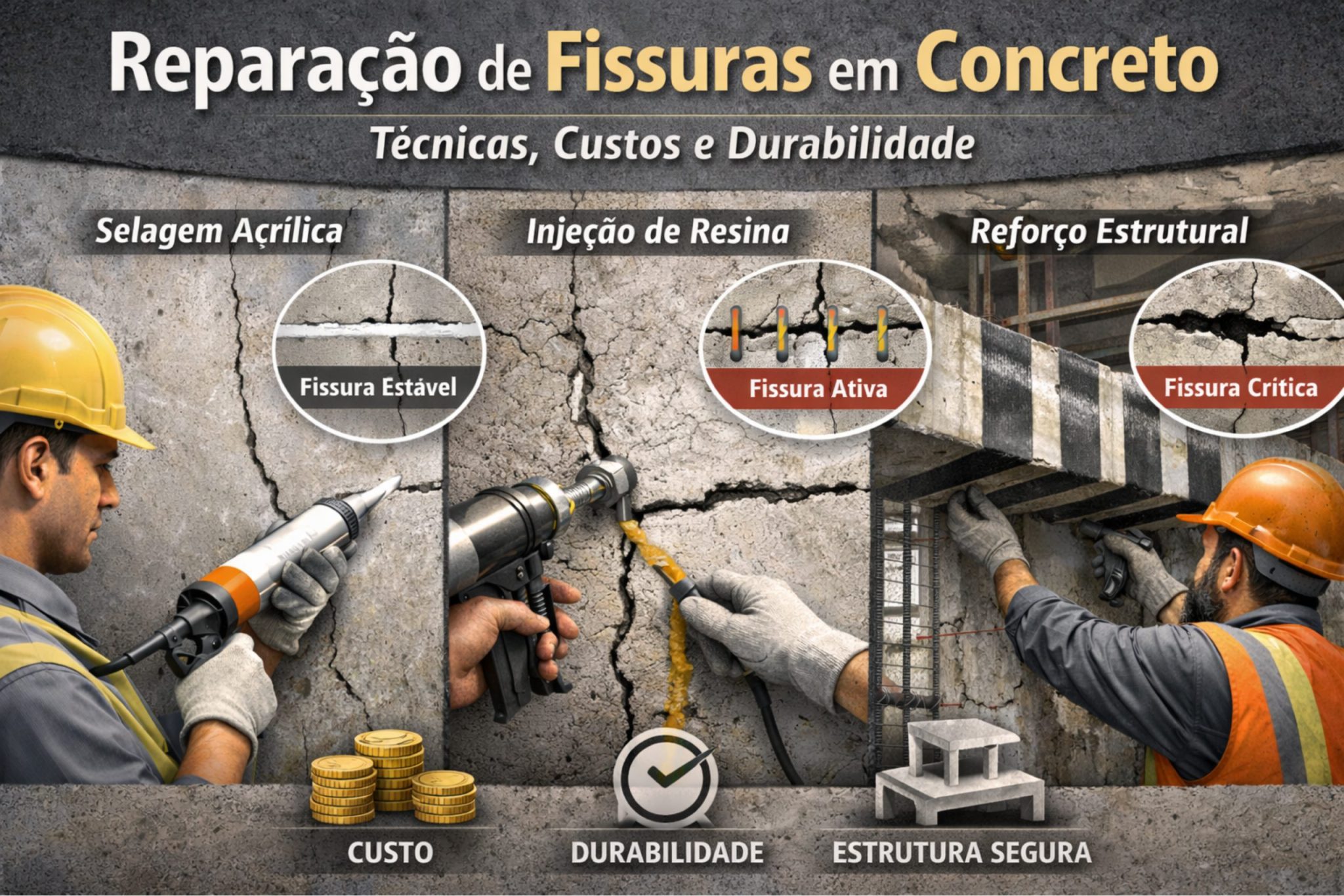
Stable cracks, with a width of less than 0.3 mm, usually allow for superficial solutions. In contrast, active cracks, between 0.3 and 0.7 mm, require structural repair techniques. Finally, critical cracks, larger than 0.7 mm, indicate the need for structural reinforcement.
In terms of cost and complexity, the progression is as follows: acrylic sealing, with an approximate cost of R$ 30 per meter and a durability of 2 to 3 years; resin injection, varying between R$ 250 and R$ 600 per meter, with a durability exceeding 10 years; and, in the most severe cases, structural reinforcements, which can reach R$ 1,200 per meter.
Consequently, choosing the right technique reduces the recurrence of pathologies and, at the same time, minimizes the overall cost over the structure's lifespan.
Technique 1: Sealing with Acrylic Sealants
Application and Technical Context
This technique is indicated for stable, superficial cracks, without movement and with a width of less than 0.3 mm. It is essentially a preventive solution, whose main objective is to prevent the entry of aggressive agents, such as water and CO₂.
Advantages
Initially, the low cost, generally between R$ 20 and R$ 50 per meter, makes acrylic sealant an economically attractive option. Furthermore, the application is quick, usually completed in a few hours. Another relevant point is the simplicity of the process, which eliminates the need for special equipment. Moreover, the aesthetic result is satisfactory and contributes to the surface protection of the concrete.
Technical Limitations
On the other hand, durability is limited, ranging between 2 and 3 years. Furthermore, there is no recovery of the structure's load-bearing capacity. As a direct consequence, when applied to active or structural cracks, reopening is practically inevitable.
Executive Process
The first step involves preparing the surface by cleaning with a steel brush and compressed air, followed by a minimum drying time of 48 hours. Then, the adjacent finishes are protected.
During the application phase, an acrylic sealant with a minimum elasticity of 25% is used, applied with a manual gun, ensuring continuous filling of the crack. The finishing is done with a slightly moistened spatula, respecting a minimum curing time of 24 hours.
Finally, when necessary, light sanding and appropriate painting are carried out after approximately 30 days.
Cost and Durability
The average total cost ranges from R$ 25 to R$ 50 per meter, considering materials and labor. In a practical example, 50 meters of crack repair results in an investment between R$ 1,250 and R$ 2,500. The estimated durability is between 2 and 3 years.
Technique 2: Epoxy Resin Injection
Application and Technical Context
Epoxy resin injection is indicated for structural cracks, active or passive, with a width between 0.3 and 0.7 mm. Unlike sealing, this technique acts directly on restoring the monolithic nature of the concrete.
Advantages
In this context, the main advantage is structural reconstruction, being able to recover up to 95% of the original strength. Furthermore, durability is high, often exceeding 10 or 20 years. Another relevant advantage is the absence of shrinkage after curing, as well as the possibility of application even on slightly damp concrete.
Disadvantages
Conversely, the cost is significantly higher, ranging from R$ 250 to R$ 600 per meter. Added to this is the need for specific equipment and specialized labor. Furthermore, the process demands rigorous execution control and a minimum curing time.
Detailed Executive Process
The process begins with the assessment and marking of the crack, including precise measurement of the width and definition of the injection points, usually spaced between 20 and 30 cm.
Next, the surface is prepared by scraping, aggressive brushing in a minimum strip of 5 cm, and cleaning with dry compressed air, respecting a minimum drying time of 24 to 48 hours.
Subsequently, holes are drilled with an approximate diameter of 10 mm and a depth of 30 mm, perpendicular to the crack. Then, the injectors are installed and fixed with quick-drying epoxy.
After the surface of the crack has been caulked, a preliminary leak test is performed with compressed air. Only then is the resin injection started, from bottom to top, with controlled pressure between 1 and 3 bar, ensuring slow and continuous progress.
Finally, after 24 hours, the injectors are removed, and the final finishing is carried out.
Cost and Durability
The total cost of the technique varies, on average, between R$ 280 and R$ 440 per meter, considering resin, injectors, skilled labor, and equipment. The expected durability is between 10 and 20 years, and can be longer when the diagnosis is correct and the execution is rigorous.
Final Considerations
In summary, choosing the right repair technique can reduce future maintenance costs by up to 80%. Although superficial solutions may seem to offer initial savings, over time they become financially unfavorable when applied outside their technical context. Similarly, active cracks always require investigation of the cause before intervention.
Therefore, repairing without diagnosing means treating only the symptom. As a consequence, the durability, structural performance, and above all, the safety of the building are compromised. Repair engineering does not allow shortcuts; it requires method, technical criteria, and well-founded decisions.