
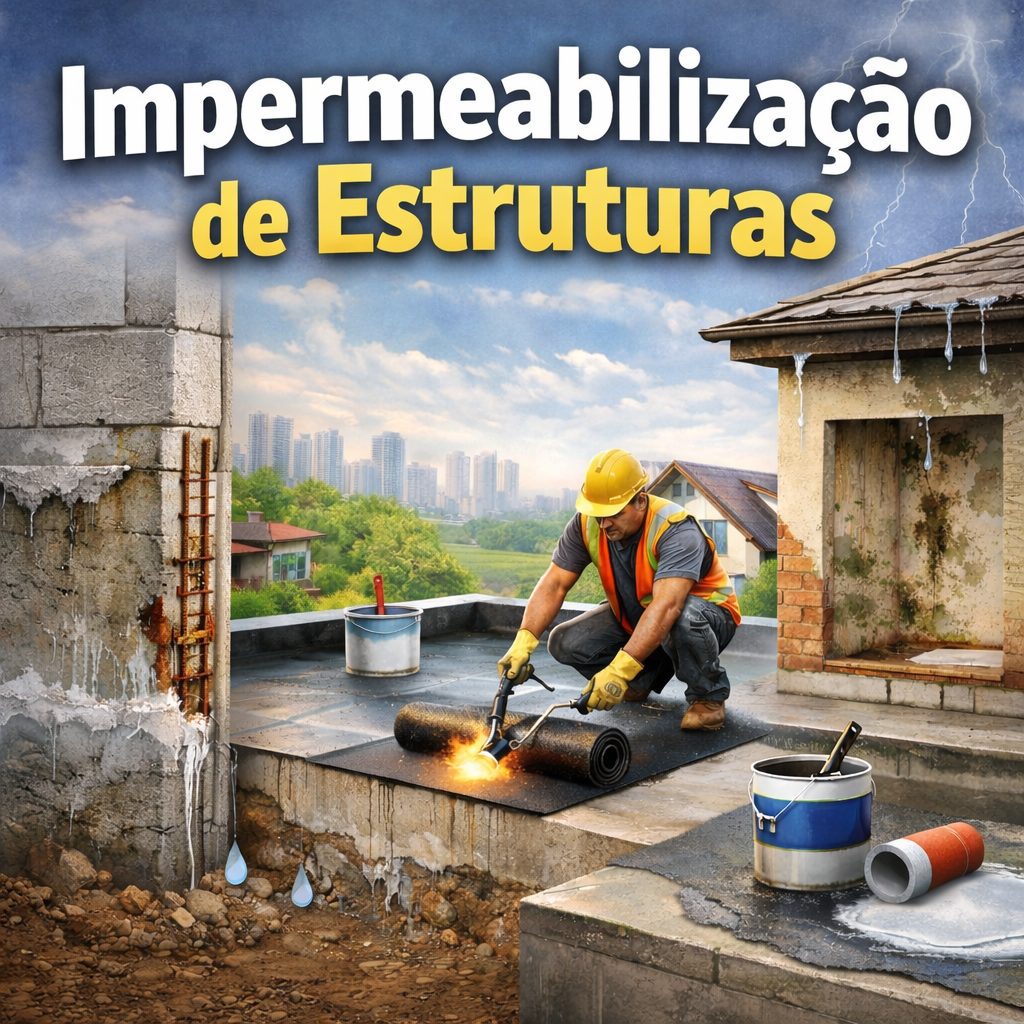


Waterproofing is one of the most critical stages in civil construction and, even so, often neglected until serious problems arise. For this reason, Investing correctly in waterproofing from the initial phase of construction avoids exponentially higher costs for future repairs. Furthermore, An untreated leak can compromise entire structures, causing corrosion of the reinforcement, proliferation of mold harmful to health and, in extreme cases, even structural collapse.
That way, In this comprehensive guide, we will explore the main types of moisture, the most commonly used waterproofing techniques, the materials available on the market, and..., above all, How to choose the ideal solution for each situation.
What is waterproofing?
Waterproofing is the set of techniques and materials used to prevent water or other fluids from entering or escaping from structures. In other words, This is a protective barrier that keeps structures dry and durable for decades.
Nonetheless, Unlike simple sealing, waterproofing is a complete technical system. I.e, It takes into account specific types of moisture, structural movements, and weather conditions. That's why, This requires careful planning even in the design phase and, subsequently, rigorous execution during construction.
Main objectives of waterproofing:
- Prevent rainwater infiltration.
- Protect against soil moisture.
- Avoid condensation in humid environments.
- Preventing corrosion of concrete reinforcement bars
- Eliminate harmful mold and mildew.
- Extending the lifespan of structures
- Maintaining healthy environments
- Preserving the value of real estate assets
Types of Humidity: The Original Problem
Before defining the waterproofing system, firstly, It is essential to identify the specific type of moisture affecting the structure. Otherwise, However, the solution adopted may be inefficient or even worsen the problem.
1. Infiltration due to Weathering
Infiltration due to weathering is, undoubtedly, the most common. Basically, This occurs due to the direct action of rain on roofs, slabs, and facades.
Main features:
- Water entering through cracks in roofs.
- Penetration through cracked facades
- Visible stains, leaks, and peeling.
- Worsening during periods of heavy rainfall.
Most affected areas:
- Roof slabs
- Sloping roofs
- Exposed facades
- Gutters and downspouts
2. Ascending Infiltration by Capillarity
In this case, moisture rises from the ground through the pores of the concrete and mortar, primarily affecting foundations and ground-floor walls. Like this, The problem tends to manifest itself progressively.
Main features:
- Origin at the base of the structure
- Vertical rise by capillarity
- Formation of efflorescence
- Intensification during periods of saturated soil.
Aggravating circumstances:
- High water table
- Permanently moist soils
- Lack of basal waterproofing.
3. Negative Pressure Infiltration
Unlike the previous ones, here the soil moisture exerts continuous pressure against the structure. Consequently, Inadequate systems end up failing.
In summary, It's not about water seeping in directly, but rather about hydrostatic pressure overcoming the impermeable barrier.
High risk in:
- Underground basements
- Boundary walls
- Structures below the water table
4. Infiltration by Condensation
Finally, condensation occurs when water vapor encounters cold surfaces and returns to its liquid state. In this context, Poor ventilation is a decisive factor.
Typical places:
- Bathrooms without adequate ventilation
- Saunas and wet areas
- Cold storage chambers
- Garages in humid climates
Two Main Strategies: Rigid vs. Flexible
In general, waterproofing systems are divided according to their structural behavior. Like this, The correct choice depends on the expected movement of the structure.
Rigid Waterproofing
Rigid systems are suitable for stable structures. I.e, places where there is no significant movement.
Materials used:
- Polymer mortar
- Water-repellent additives
- Epoxy resins
- Crystallizing products
Application:
- Direct application to the base
- Typically without additional layers.
- Traditional and widely used method
Recommended for:
- Elevator shafts
- Reservoirs and swimming pools
- Stable subsoils
- Vibration-free indoor areas
Advantages:
- High mechanical and chemical resistance.
- Excellent performance in harsh environments.
- Long-lasting durability
- Moderate cost
Disadvantages:
- Does not tolerate movement.
- It can crack during thermal cycles.
- Incompatible with expandable structures.
Flexible Waterproofing
On the other hand, flexible systems follow the natural movements of the structure. In this way, significantly reduce the risk of cracking.
Materials used:
- Acrylic membranes
- Asphalt blankets
- Liquid rubber
- Liquid polyurethane
- Water repellents
Recommended for:
- Flat slabs
- Sloping roofs
- Exposed facades
- Regions with temperature variation
Conclusion: Waterproofing is an essential investment.
In short, waterproofing is not just a protective layer. In practice, This is a critical structural system. That's why, Investing correctly at this stage is incomparably more economical than carrying out future repairs.
In fact, Untreated water infiltration accelerates structural degradation. Consequently, Simple problems can compromise the entire building in just a few years.
Like this, The technical recommendation is straightforward: correctly identify the type of moisture and specify the appropriate system. In contrast, Saving money at this stage almost always results in significant losses in the future.