




Water infiltration is currently the most common problem in Brazilian buildings. In fact, Technical studies indicate that approximately 60 to 70% of urban properties They exhibit some type of water infiltration throughout their lifespan. Furthermore, This problem is not limited to aesthetics, as it causes progressive structural deterioration, compromises the health of the occupants, and generates significant financial losses.
Nonetheless, The biggest misconception associated with leaks is not that they occur, but rather that... incorrect diagnosis of the origin. In practice, approximately 80% repair attempts fail Because they only treat the visible symptom, the stain, and not the real cause of the water entering the building. Consequently, However, the problem persists, even after expensive interventions.
In this context, Diagnosing leaks requires structured investigative reasoning. This happens because, In most cases, the water does not manifest itself at the point where it enters the building. On the contrary, It travels horizontally and vertically through slabs, beams, and masonry before becoming visible.
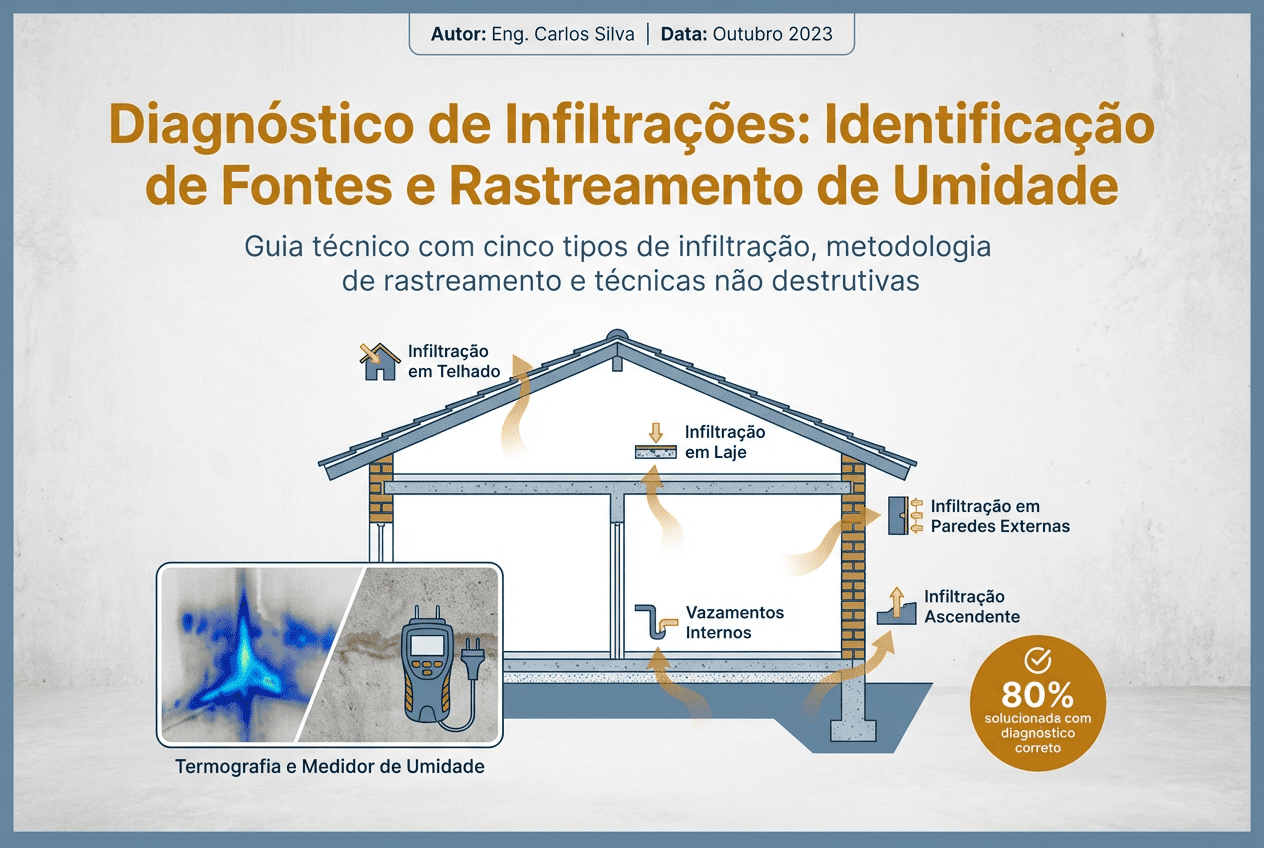
Like this, This technical guide presents the five main types of infiltration, a tracking methodology, techniques non-destructive diagnostic and a complete case study, with a structured solution.
Five Main Types of Infiltration: Origin and Manifestation
Each type of infiltration has a specific origin, mechanism, and solution. Therefore, Correct classification is crucial for successful repair.
Type 1: Downward Infiltration (Rain / Weather) – 45% of cases
Origin:
Rainwater seeping down from above through roofs, facades, and slabs.
Mechanism:
Rain on roof or facade ↓ Waterproofing failures, cracks or open joints ↓ Penetration into porous concrete or masonry ↓ Migration through connected pores ↓ Internal manifestation ↓ MANIFESTATION: stain, mold and peeling
Main technical causes:
1. Expired waterproofing 2. Unsealed expansion joints 3. Structural cracks 4. Clogged gutters 5. Insufficient roof pitch 6. Damaged tiles or slabs
Pattern of manifestation:
Location: ceilings and upper walls; Pattern: large areas; Timing: after rain; Progression: seasonal
Specifically, This type manifests itself quickly, as the origin is usually close to the visible location.
Type 2: Ascending Infiltration (Capillarity) – 25% of cases
Origin:
Groundwater rising through the foundation.
Mechanism:
Moist soil in contact with foundation ↓ Absorption by capillary pores ↓ Rise against gravity ↓ Height: 0.5 to 2.0 m ↓ MANIFESTATION: stains at the base of walls
Typical ascent height:
Dense concrete: 0.5–0.8 m Common masonry: 1.0–1.5 m Porous masonry: 1.5–2.0 m
Main causes:
1. Lack of waterproofing 2. Damaged waterproofing 3. High water table 4. Poor drainage
Pattern of manifestation:
├─ Base of the walls ├─ Saline efflorescence └─ Slow and continuous progression
On the other hand, This is one of the most difficult types to treat, as it involves interventions at the foundation level.
Type 3: Lateral Infiltration (Horizontal Pressure) – 15% of cases
Origin:
Water from the ground or from the outside is pressing against the side walls.
Mechanism:
Lateral soil pressure ↓ Waterproofing failure ↓ Horizontal penetration ↓ MANIFESTATION: localized stains
Typical pattern:
├─ Buried walls ├─ Localized stains └─ Continuous dampness
In that case, Perimeter drainage is a critical factor.
Type 4: Infiltration by Condensation – 10% of cases
Origin:
Condensation of internal water vapor.
Mechanism:
Hot air meets a cold surface ↓ Moisture saturation ↓ Droplet formation ↓ MANIFESTATION: mold and stains
Differential diagnosis:
Condensation: ├─ Appears in cold areas ├─ Reduces with ventilation └─ Does not cause structural damage Actual infiltration: ├─ Deep dampness ├─ Persistent └─ Progressive deterioration
In fact, approximately 30 to 40% of the wrong diagnoses This confusion stems from the confusion.
Type 5: Infiltration due to Leaking Pipes – 5% of cases
Origin:
Faults in hydraulic or rainwater pipes.
Standard:
├─ Well-defined stain ├─ Precise location └─ Direct relationship with water use
Diagnostic Methodology: 7 Investigative Steps
The diagnosis must follow technical protocols. Like this, It is recommended to apply the steps below.
Step 1: Technical Interview
The answers guide the investigation. Therefore, This phase is strategic.
Step 2: Visual Inspection
Right away, The mapping of the spots and cracks is then carried out.
Step 3: Humidity and Temperature Measurement
That way, It is possible to differentiate between condensation and actual water infiltration.
Step 4: Infrared Thermography
Furthermore, Thermography allows for the identification of hidden leaks without the need for demolition.
Step 5: Waterproofing
When necessary, Controlled water is applied for confirmation.
Step 6: Documentary Investigation
Finally, The project design, the age of the waterproofing, and the maintenance history are analyzed.
Step 7: Integrated Diagnostics
Consequently, In this context, diagnosis, root cause, and correct solution are defined.
Cost of Diagnosis vs. Benefit
In summary, Correct diagnosis significantly reduces costs.
Inadequate diagnosis: ├─ Wrong repairs ├─ High cost └─ Recurring problem Correct diagnosis: ├─ Technical inspection ├─ Targeted repair └─ Savings of up to 75%
Conclusion: Correct Diagnosis is Half the Solution
In conclusion, In practice, a correctly diagnosed infiltration is..., 80% resolved. Therefore, Proper repair naturally follows once the root cause is identified.
Like this, Investing in technical diagnostics is not a cost, but a strategically, economically, and structurally intelligent decision.