



In general, most people only think about sprinklers when they see a fire on the news. However, The technical reality is clear: sprinklers save lives. In fact, Buildings equipped with automatic sprinkler systems reduce the risk of death in fires by more than 85%.
Despite this, many homeowners still resist installing the system. Normally, This resistance occurs for two main reasons: the perception of high cost and the fear of visual impact. Nonetheless, The truth is that modern sprinklers are relatively inexpensive and integrate discreetly into the ceiling.
In this context, This article explains how sprinklers work, the different types available, how they are installed, the applicable technical standards, the costs involved, and, most importantly, why every modern building should have this safety system. At the end, It will become clear why sprinklers represent an investment worth every penny spent.
What is a sprinkler?
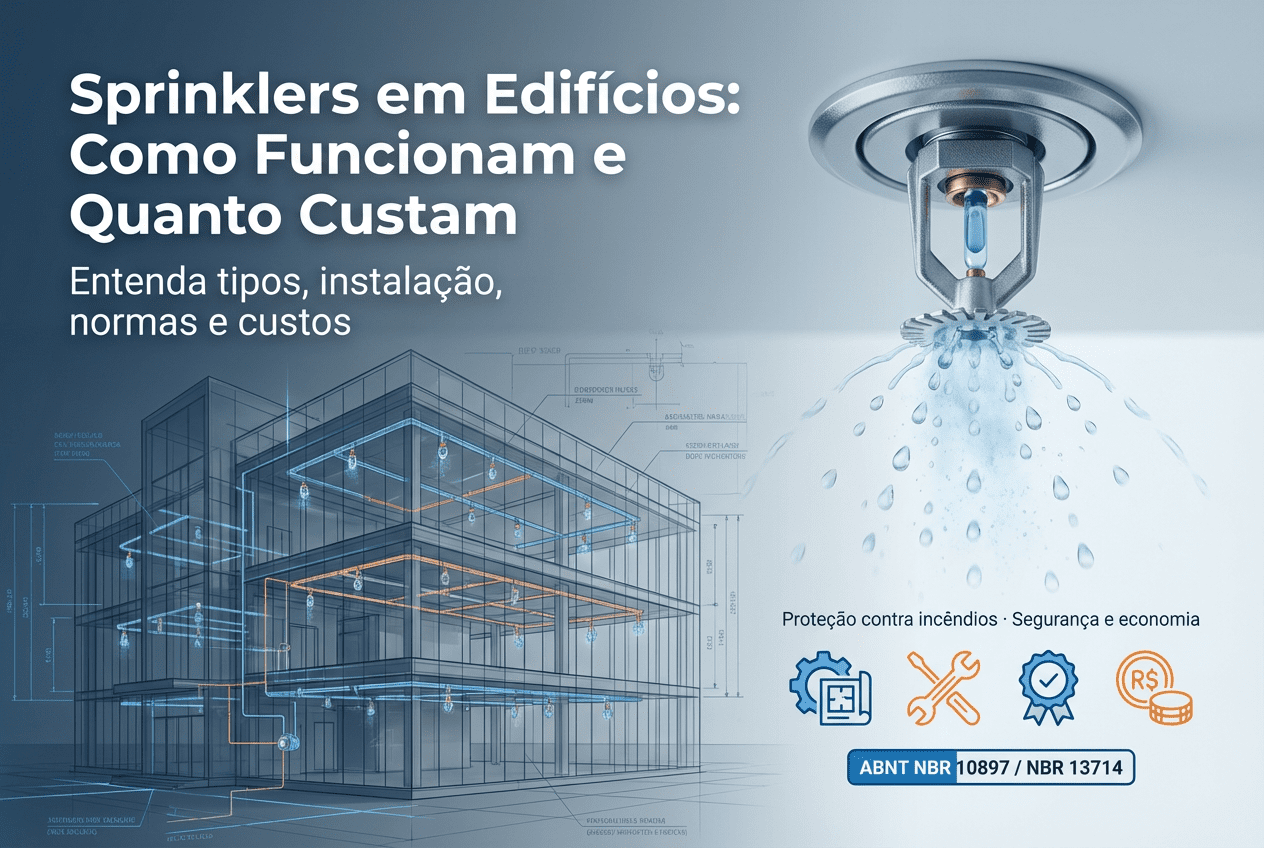
A sprinkler is an automatic fire suppression device that releases water when it detects an excessive increase in temperature. Differently Unlike fire hydrants, which depend on human action, sprinklers operate completely automatically.
Basic Operation
When the temperature around the sprinkler reaches typical values between 57 °C and 68 °C, A heat-sensitive element breaks. Like this, The valve opens and the pressurized water is released immediately.
As a result, the water jet:
- It cools the environment, reducing the temperature.
- It moistens flammable materials, hindering the spread of the virus.
- It generates steam, reducing the oxygen concentration.
Combined, These effects control or extinguish the fire until the Fire Department arrives.
Difference Between a Sprinkler and a Fire Hydrant
| Aspect | Sprinkler | Hydrant |
|---|---|---|
| Activation | Automatic | Manual |
| Response | Seconds | Minutes |
| Coverage | Located | Centralized |
| Efficiency | Very high (85%+) | Average |
| Cost | Average | Low |
| Maintenance | Periodical | Minimum |
Therefore, The sprinkler exhibits superior performance in virtually all critical criteria.
How a Sprinkler System Works Technically
Although the principle is simple, the system's engineering is extremely effective.
Main Components
- Distribution piping
- Check valve
- Heat-sensitive element
- Exit hole
- Dispersion deflector
Operating Cycle
Initially, The system remains pressurized and in standby mode.
Right away, As the temperature increases, the heat-sensitive element reaches its critical point.
Consequently, The element breaks and the valve opens.
Immediately after, The water is released and distributed in the form of rain.
Finally, The fire is controlled or extinguished.
Water Pressure
The system generally operates with continuous pressure between 40 and 50 psi (2.8 to 3.5 bar). That way, This ensures rapid release, good dispersion, and adequate range.
Types of Sprinklers
There are different types, each suited for a specific application.
1. Wet Drop Sprinkler
In this model, The water remains constantly inside the pipe.
Advantages:
- Extremely fast response
Nonetheless, It is not the most suitable option for environments subject to freezing.
Application: residences, offices and shops
Cost: R$ 150 to R$ 300 per unit
2. Dry Pipe Sprinkler
In this case, The tube contains pressurized air, and water only enters after the trigger is activated.
On the other hand, The response is a little slower.
Application: cold storage rooms, outdoor areas and warehouses
Cost: R$ 300 to R$ 600 per unit
3. Quick Response Sprinkler
Furthermore, There are sprinklers designed to detect heat earlier.
Consequently, they reduce smoke damage.
Application: hospitals, schools and nursing homes
Cost: R$ 200 to R$ 400 per unit
4. Special or Concealed Sprinkler
Visually, This model is integrated into the roof.
Nonetheless, It has a higher cost.
Application: hotels, restaurants and high-end areas
Cost: R$ 400 to R$ 800 per unit
How is a Sprinkler System Installed?
The installation follows a rigorous technical process.
Phase 1: Engineering Project
Firstly, The engineer determines the number of sprinklers, pipe diameters, required pressure, and the location of pumps and reservoirs.
- Duration: 2 to 4 weeks
- Cost: R$ 5,000 to R$ 15,000
Phase 2: Pipe Preparation
Right away, The pipes are installed along the ceiling and walls, with adequate support.
- Duration: 3 to 6 weeks
Phase 3: Sprinkler Installation
Later, The heads are positioned according to technical spacing.
- Apartment 100 m²: 3 to 5 sprinklers
- Building with 30 units: 90 to 150 sprinklers
Phase 4: Central System
At that time, Pumps, tanks, valves, and alarms are installed.
Phase 5: Testing and Commissioning
Finally, The system is fully tested, documented, and released for operation.
Applicable Technical Standards
- ABNT NBR 10897 Sprinkler systems
- ABNT NBR 13714 Integration with fire hydrants
Furthermore, municipal laws in SC may require sprinklers in tall buildings, large areas, or mixed-use properties.
Sprinkler System Costs
Residential Building (30 units)
Total cost: R$ 130.000
Cost per unit: R$ 4.330
Commercial Building (1,000 m²)
Total cost: R$ 195.000
Cost per m²: R$ 195
Comparison: Cost vs. Benefit
Although Even though the initial investment is significant, the benefits outweigh the costs.
- Reduction of 20–30% in insurance
- Annual savings of R$ 20,000 to R$ 40,000
- Return on investment in 3 to 7 years.
Furthermore, Lives are preserved.
Maintenance and Inspection
- Annual inspection: R$ 2000 to R$ 5000
- Flow test (5 years): R$ 5,000 to R$ 10,000
- Recertification (10 years): R$ 15,000 to R$ 25,000
Consequently, The reliability of the system is maintained.
Practical Cases of Effectiveness
Real-life cases in Blumenau, Joinville, and Navegantes demonstrate that sprinklers control fires quickly, prevent deaths, and reduce losses. Like this, Its effectiveness is not theoretical, but proven.
When to Install Sprinklers?
- During construction: cheaper and more efficient
- During major renovations: diluted cost
- In retrofit: More expensive, but still feasible.
Conclusion
In short, sprinklers are automatic fire protection systems that work in seconds and control fires in more than 85% of the cases.
Therefore, Despite the initial cost, the system pays for itself through savings on insurance and, above all, offers a level of security that no other standalone equipment can provide.
Every modern building in Santa Catarina should have sprinklers. If yours doesn't yet, the technical recommendation is clear: evaluate their implementation as soon as possible.