
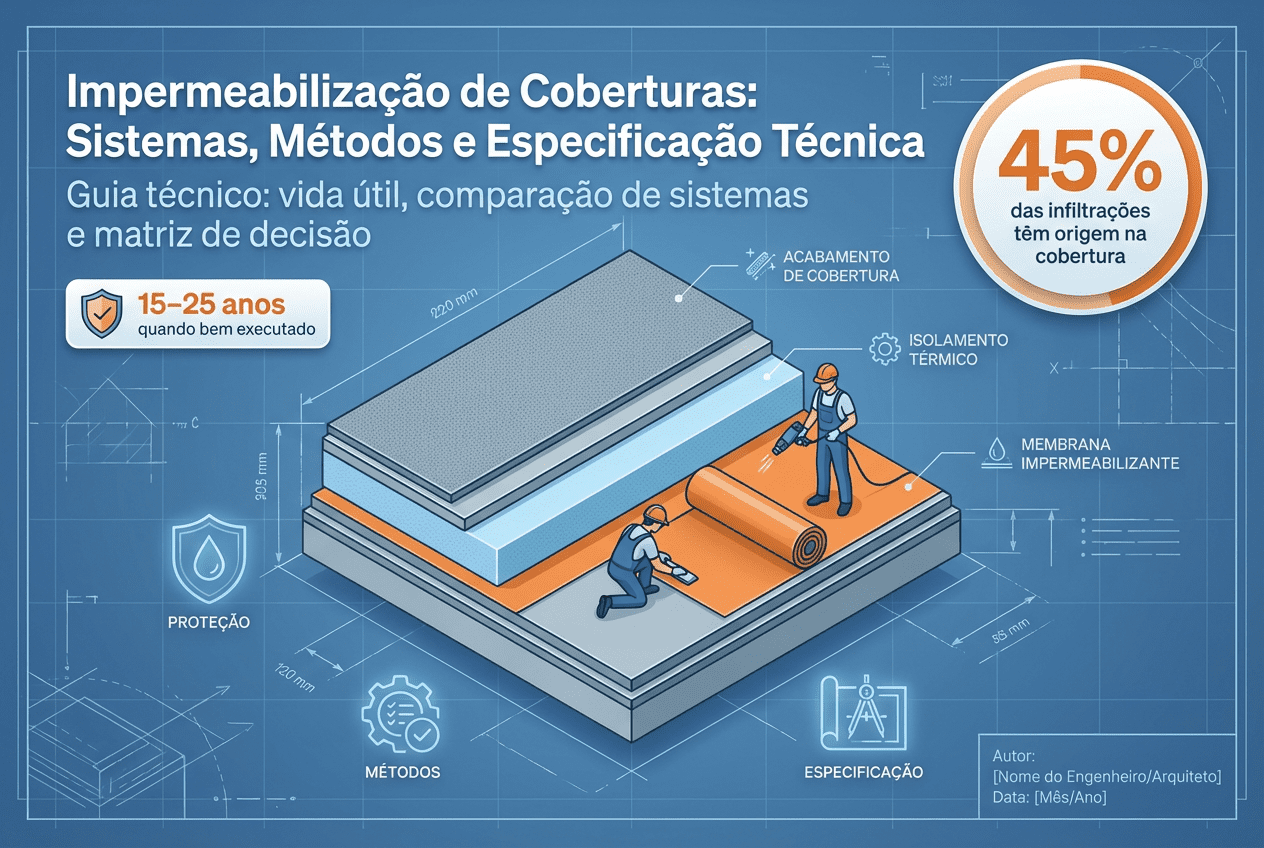
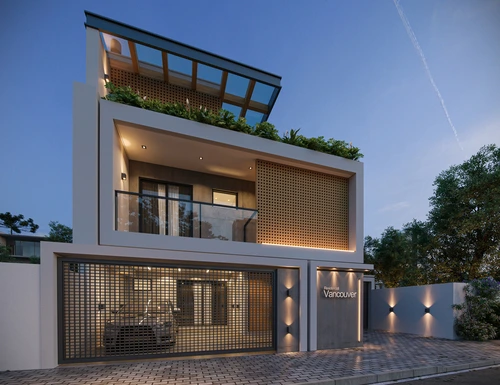
Roof waterproofing is the most critical line of defense against leaks. e, This, consequently, directly impacts the lifespan of the structure. When well executed, A waterproofing system can last between 15 and 25 years old. On the other hand, Failures in this system reduce this lifespan to just 3 to 5 years.
That way, To correctly specify the system, considering the type of roofing and environmental exposure. e The possibility of maintenance becomes a strategic design decision. Furthermore, Technical data indicates that 45% of the leaks originate from failures in the waterproofing of the roof.. Like this, Saving money in the initial phase usually results in a higher cost. 10 to 20 times larger with future structural repairs.
In this context, This technical guide presents the main waterproofing systems, their characteristics, application methods, and expected lifespan. e, Finally, a decision matrix for correct specification.
Main Systems: Characteristics and Comparison
Currently, there are five main systems Roof waterproofing. In general, Each has its advantages and limitations. e specific applications, which requires careful analysis during the design phase.
System 1: Asphalt Membrane (55% from the market) – Traditional and Reliable
Description
Asphalt roofing felt is a prefabricated membrane composed of asphalt modified with polymers. Furthermore, It is structured with a reinforcement of polyester, polyethylene or fiberglass, which guarantees mechanical resistance.
Technical Composition
Main layers: ├─ Bottom face: Polyethylene or polyester film ├─ Core: Asphalt modified with SBS or APP ├─ Structural reinforcement: Polyester, polyethylene or glass ├─ Top face: Polyethylene film, sand or granules └─ Typical thickness: 3–4 mm (single) or 8 mm (double)
Modifying Polymers
| Type | Heat Resistance | Low Temp Flexibility | Useful Life | Cost |
|---|---|---|---|---|
| SBS | <100°C | ≤ -30°C | 15–20 years old | Average |
| APP | up to 140°C | ≤ -15°C | 10–15 years | Average |
| Rusty | <80°C | >0°C | 5–7 years | Low |
Generally speaking, However, SBS performs better in cold regions. The app, in turn, is more suitable for warm environments.
Actual Useful Life
Single layer: 5–7 years. Double layer: 15–20 years. With proper maintenance: +5–10 years.
System 2: Liquid Membrane (30% from the market) – Flexible and Modern
Description
The liquid membrane is applied cold. e, After healing, it forms a continuous, seamless membrane. Consequently, It eliminates common weak points in traditional systems.
Advantages
✓ Seamless, therefore lower risk of water infiltration ✓ Better adaptation to construction details ✓ Safer application, as it does not use a flame ✓ Simplified future maintenance
Limitations
Sensitive to moisture during application. Lower resistance to heavy traffic. Requires UV protection, especially in exposed areas.
System 3: Waterproofing Paint (10% from the market)
This system is mainly used for maintenance. Nonetheless, It should not be adopted as a definitive solution.
Short lifespan. Low initial cost. Need for frequent reapplication.
System 4: Chemical Injection (3% from the market)
Chemical injection is recommended for localized repairs. I.e, It acts as a corrective solution, not a preventative one.
Spot use. Does not replace complete waterproofing. Limited lifespan.
System 5: Green Roof (2% from the market)
A green roof combines waterproofing and sustainability. Furthermore, protects the blanket against UV rays and temperature variations.
Greater system durability. Higher initial cost. Higher structural load.
Critical Construction Details
Regardless of the system adopted, the construction details are crucial. In fact, approximately 40% The performance of waterproofing depends on correct execution. of drains, parapets, joints and penetrations.
Preventive maintenance
With proper maintenance, it is possible to significantly extend the system's lifespan. That's why, Periodic inspections are essential.
Monthly: visual inspection. Semi-annual: cleaning and verification. Annual: complete technical inspection.
Conclusion
In short, roof waterproofing should be treated as a strategic investment. Although the initial cost may be slightly higher, in the long term The savings from structural repairs are significant.
Therefore, Prioritize durability and correct technical specifications. e Good execution drastically reduces the total cost of the building over its lifespan.