

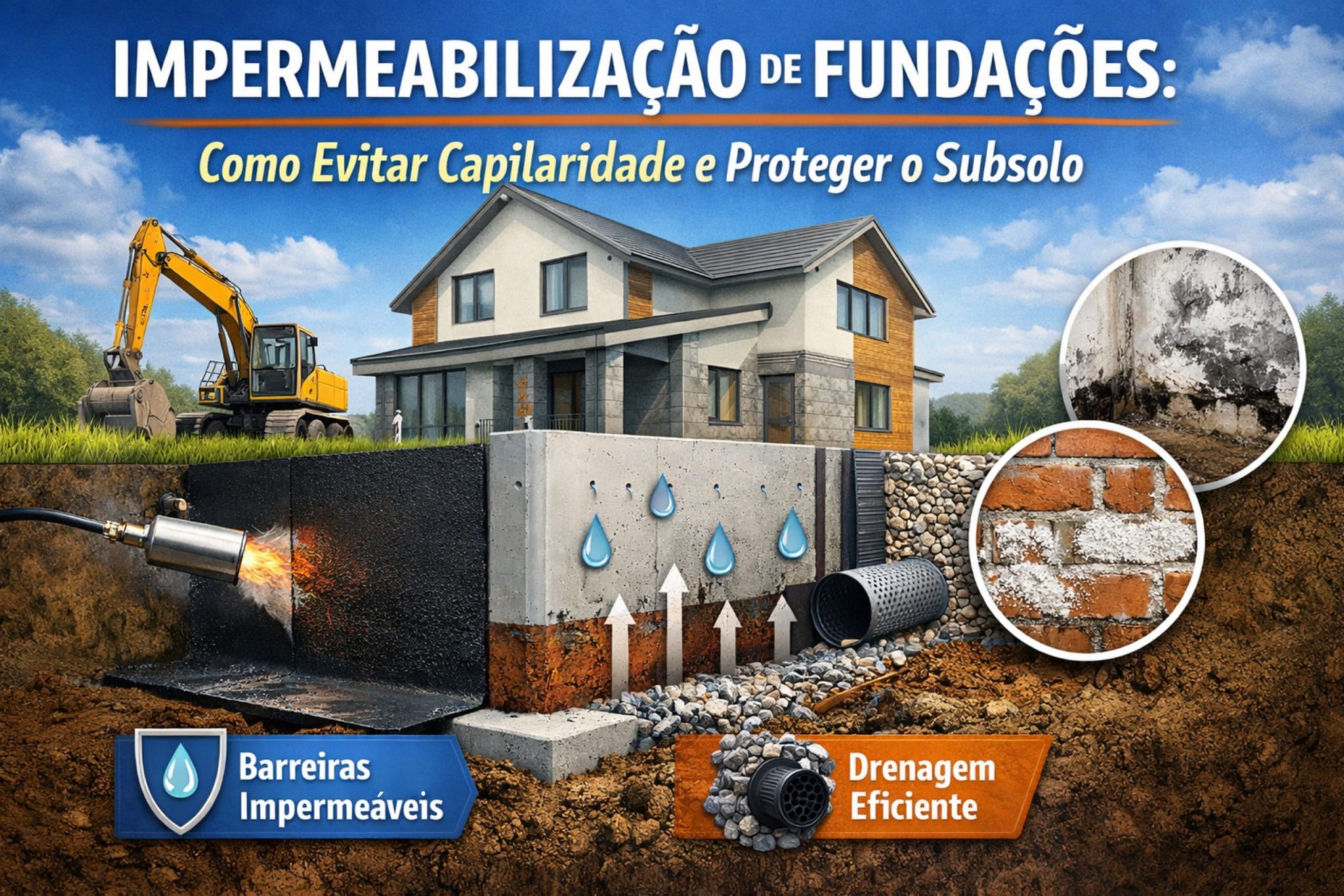


Foundation waterproofing represents the most critical line of defense to prevent upward infiltration by capillarity. At the moment, This phenomenon is responsible for approximately 25 to 30% of pathologies in Brazilian buildings. When neglected, This stage causes progressive damage that affects foundations, masonry, and finishes for decades.
For this reason, Proper specification of the waterproofing system, combined with efficient drainage, is essential in any project. In practice, The difference between a well-waterproofed and drained foundation and a poorly executed one determines whether the building will have a longer lifespan than expected. 50 years or it will exhibit severe degradation in 15 to 20 years old.
In this context, This technical guide details foundation waterproofing systems, capillary barrier methods, and perimeter drainage solutions. e, Above all, the correct implementation protocols are in place to ensure full protection of the subsoil.
The Problem: Upward Infiltration by Capillarity
Detailed Physical Mechanism
Water-saturated soil in contact with the foundation ↓ Capillary pores in concrete or masonry absorb water ↓ Capillary phenomenon: water rises against gravity (0.5–2.0 m) ↓ Dissolved salts (chlorides, sulfates) accompany the water ↓ Evaporation of water on the inner surface of the walls ↓ Crystallization of salts (efflorescence) and degradation of the material ↓ MANIFESTATION: Stains, mold, and disintegration
Generally speaking, The height of capillary rise depends directly on the pore size of the material. The smaller the pore, The higher the water rises, the greater it tends to be.
Typical Height of Hair Rise
Well-executed concrete: 0.5–1.0 m Ordinary masonry: 1.0–1.5 m Porous masonry: 1.5–2.0 m
Difference between waterproofing and drainage.
Although distinct, these solutions are complementary, not mutually exclusive.
WATERPROOFING: ├─ Blocks water ingress ├─ Creates a physical or chemical barrier └─ Protects floors and walls DRAINAGE: ├─ Removes water before it reaches the foundation ├─ Directs the flow away from the structure └─ Reduces hydrostatic pressure EFFICIENT SYSTEM = Waterproofing + Drainage
System 1: Waterproofing of Foundation Beams (Most Critical Stage)
The foundation beams receive the load of the entire building. Consequently, Flaws in this waterproofing allow moisture to contaminate. all the masonry above.
Method 1A: Asphalt Blanket + Water-Repellent Mortar
Execution Process
Initially, The beam is then properly prepared:
1. Thorough surface cleaning 2. Concrete curing for at least 28 days 3. Application of asphalt primer 4. Complete drying (RH < 70%)
Right away, The asphalt membrane is applied:
1. Double layer of 8 mm membrane 2. Heat fusion with a torch 3. Continuous pressure for adhesion 4. Minimum overlap of 10 cm 5. Membrane rise 20–30 cm laterally
Later, Lateral sealing and mechanical protection are then performed.
Mortar with water-repellent additive. Thickness: 3–5 cm. Minimum curing time: 7 days.
Finally, The masonry is then laid using waterproof mortar. e, simultaneously, the perimeter drainage.
Approximate Cost
TOTAL: R$ 150–240 per linear meter Example (100 m): R$ 15,000–24,000
Method 1B: Hydrophobic Resin Injection (Post-Construction)
When the building already has signs of water infiltration., Resin injection is an effective corrective solution.
Drilling at the base of the wall. Injection under controlled pressure. Blocking of capillary pores. Formation of a chemical barrier.
In this scenario, the solution is effective in approximately 80% of the cases, without the need for demolition.
System 2: Waterproofing of Slabs in Contact with the Ground
Basement slabs are subject to constant water pressure. That's why, They require robust systems.
Method 2A: Double System with Drainage
Compacted soil, geotextile separator, drainage system (geocomposite), filtering geotextile, waterproofing membrane, structural slab.
That way, The water is drained before reaching the blanket, drastically reducing hydrostatic pressure.
Estimated lifespan:
30 to 40 years old
System 3: Protection of Underground Walls
Interior Waterproofing
Although common, This method only works on internal blockages.
Wall drying; Crack repair; Application of polymer mortar or membrane; Mechanical protection.
Nonetheless, It does not eliminate external water pressure.
Exterior Waterproofing (Ideal)
Technically, is the most efficient solution. Although, In existing buildings, this is usually unfeasible due to the high cost and the need for complete excavation.
System 4: Perimeter Drainage (Most Neglected Element)
Well-executed perimeter drainage can reduce up to 80% of infiltration problems.
Surface channels Drainage trenches around the foundation Perforated pipes wrapped in geotextile Inspection boxes Safe disposal point
Real ROI
Average cost: R$ 8,800 Repairs avoided: R$ 200,000+ Return: > 2,000%
Practical Example: Commercial Basement
After technical diagnosis, Upward infiltration by capillarity was identified.
- Palliative solution: failure in 2–3 years
- Suitable solution: cost R$ 73,000–82,000, useful life 20 years
- Complete solution: R$ cost 200,000–280,000, lifespan 40 years
Therefore, The intermediate solution offered the best cost-benefit ratio.
Critical Execution Details
Foundation-Masonry Interface
Correct:
Complete continuity of waterproofing.
Wrong:
Interruption in the foundation beam
Preventive maintenance
Monthly: visual inspection. Semi-annually: drainage check. Annually: cleaning and assessment. Every 5–10 years: complete inspection.
Conclusion
In summary, foundation waterproofing It's not a cost., but strategic investment. When combined with proper drainage, guarantees durability exceeding 50 years.
Therefore, invest 3 to 5% of the value of the work at this stage avoid 80 to 90% of future costs with structural repairs.