

If you are building or buying an apartment, you have probably already heard of NBR 15.575. However, Few people actually know what this rule really means.
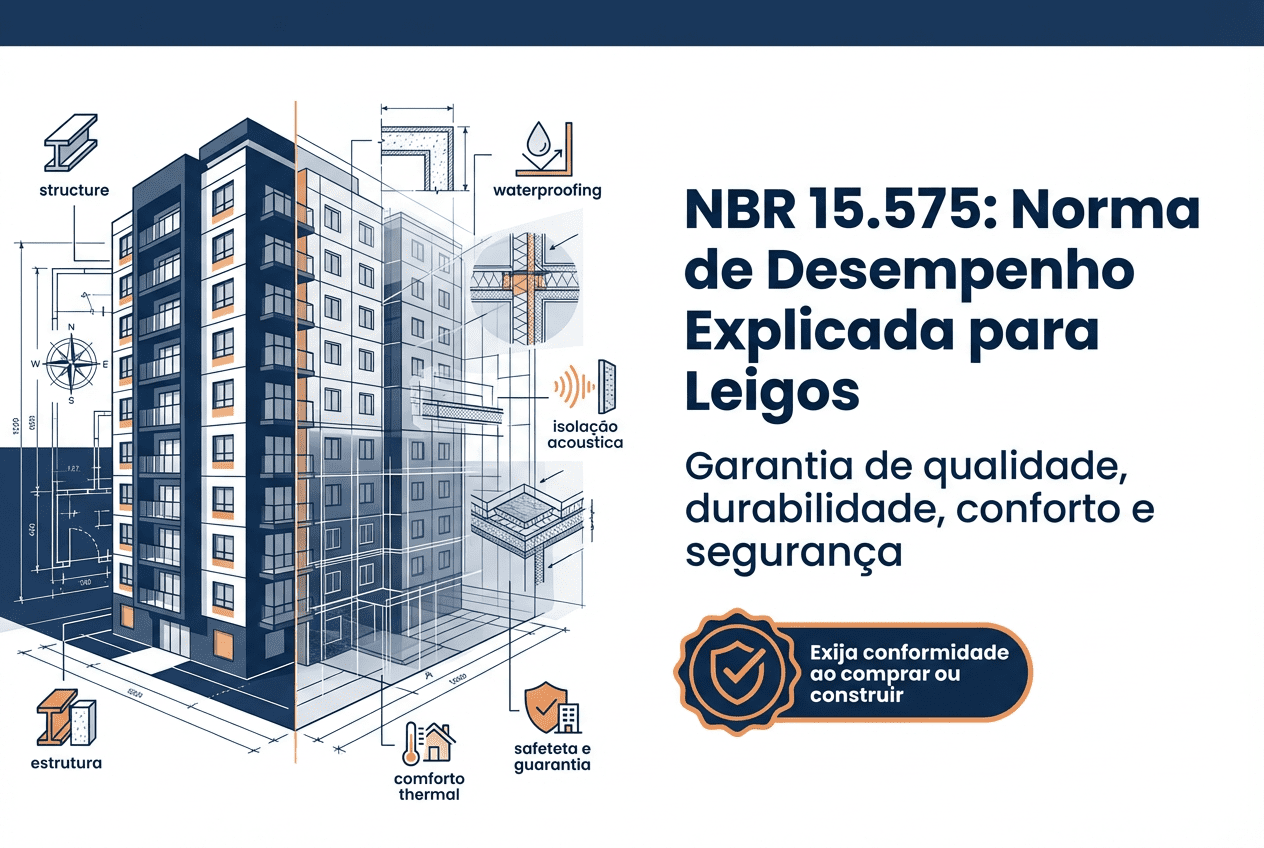
In practice, NBR 15.575 is the standard that defines How residential buildings should function. Furthermore, it establishes minimum requirements for quality, durability, comfort and safety. Therefore, when a building does not comply with this standard, legal problems arise, resale becomes difficult, and above all, serious flaws occur in daily use.
Therefore, in this article you will understand what NBR 15.575 is, why it was created, what its main requirements are, how verification occurs, and finally, what to do if the building is not in compliance. Thus, it will become clear why this standard is essential for buyers and owners.
What is NBR 15.575?
NBR 15.575 is the Brazilian Standard for the Performance of Single-Story Dwellings and Residential Buildings. In simple terms, she defines the minimum quality standard which houses and apartments must have.
In other words, despite the technical name, the concept is straightforward: All residential housing in Brazil must meet the criteria of this standard..
History of the Norm
Before 2013, Brazil did not have a national performance standard. Thus, a building constructed in one city could have a completely different quality than one in another region.
As a direct consequence, many buildings suffered from leaks, acoustic failures, thermal discomfort, and even structural problems. Furthermore, there was no clear technical basis for holding construction companies liable.
For this reason, in 2013, ABNT created NBR 15.575. Since then, a mandatory minimum standard has existed for residential buildings, guaranteeing greater predictability and safety for the consumer.
Who is responsible?
In short, the responsibilities are clear:
- Construction company: performs the work in accordance with NBR 15.575
- Developer: ensures that the construction company complies with the standard.
- Owner: is the direct beneficiary
Therefore, if the building does not comply with the standard, the owner can:
- Demand corrections at no cost.
- Request contractual penalties
- Take legal action against the construction company.
Why is NBR 15.575 important?
Many people believe that the rule is just bureaucracy. Nonetheless, However, this does not correspond to reality. In practice, it offers concrete protection to the buyer.
1. Guarantees Minimum Quality
Without the standard, construction companies could deliver properties with poor performance. With NBR 15.575, there is a minimum limit that must be respected.
Therefore, In this way, the buyer is not at the mercy of subjective standards.
2. Standardize Security
Furthermore, the standard establishes clear safety requirements, such as:
- Stable structure
- Safe electrical installations
- Functional drainage
Consequently, The risk of accidents and serious failures is reduced.
3. Establishes Guarantee Rights
Another key point is defining warranty periods. Therefore, if a problem arises within these periods, the construction company must correct it.
That way, In this way, the consumer is legally protected.
4. Facilitates Financing
Furthermore, banks require compliance with NBR 15.575 to release mortgage loans.
Logo, Properties that do not meet the standard tend to have more difficulty obtaining financing.
5. Increases the Property Value
Finally, properties that comply with the standard are more valuable on the market.
I.e, This also involves asset protection.
Main Requirements of NBR 15.575
The standard covers several aspects of performance. The main ones are listed below.
1. Structural Performance
Requirement: The structure must withstand all anticipated loads without risk of collapse.
Tests:
- Structural calculations
- Verification of columns and beams
- Deformation control
Like this, The building must not have excessive cracks or structural risks.
2. Fire Safety
Requirement: The building must allow for safe evacuation in case of fire.
Tests:
- Verification of escape routes
- Evaluation of materials
- Visual inspections
Therefore, Residents are able to leave safely.
3. Water tightness
Requirement: To prevent water from entering facades, slabs, and wet areas.
Tests:
- Leakage tests
- Crack inspection
- Drain inspection
Consequently, This prevents leaks and mold.
4. Thermal Performance
Requirement: to ensure adequate thermal comfort for the local climate.
Tests:
- Thermal transmittance calculation
- Evaluation of window and door frames
- Thermal simulations
Like this, The property does not become uncomfortable throughout the year.
5. Acoustic Performance
Requirement: Reduce noise between units and from the external environment.
Tests:
- Acoustic measurements
- Evaluation of walls and slabs
That way, There is more sound privacy.
6. Lighting Performance
Requirement: ensure minimum natural lighting.
Tests:
- Natural light factor calculation
- Illuminance verification
Therefore, The rooms don't become excessively dark.
7. Indoor Air Quality
Requirement: Adequate ventilation and air renewal.
Tests:
- Verification of openings
- Renewal calculation
Like this, The indoor air remains healthy.
8. Safety in Use — Floors
Requirement: Non-slip and durable flooring.
Tests:
- Coefficient of friction
- Impact resistance
Logo, This reduces the risk of falls.
9. Safety in Use — Handrails and Guardrails
Requirement: resistance to horizontal forces.
Tests:
- Load application
- Dimensional verification
Consequently, This prevents serious accidents.
10. Safety in Use — Glass
Requirement: Use of safety glass in critical areas.
Tests:
- Type verification
- Impact tests
Like this, Injuries are minimized.
11. Sanitary Facilities and Drainage
Requirement: Proper functioning of the water and sewage system.
Tests:
- Leakage tests
- Drainage tests
Therefore, There is no backflow or clogging.
12. Corrosion Resistance
Requirement: adequate protection of the armor.
Tests:
- Coverage measurement
- Visual inspections
Therefore, This increases the durability of the structure.
Warranty Periods in accordance with NBR 15.575
| Component | Term |
|---|---|
| Structure | 10 years |
| Seals | 5 years |
| Plumbing and Sanitary | 5 years |
| Electric | 5 years |
| Finishes | 1 year |
| Doors and windows | 2 years |
Important: These timeframes are technical guarantees. The contractual guarantee may be longer.
Conclusion
In summary, NBR 15.575 is an essential standard for the Brazilian construction industry. It guarantees safety, comfort, and durability.
Therefore, when buying or building, require compliance with NBR 15.575. Ultimately, this is not an optional benefit; it is a right of the homeowner.