

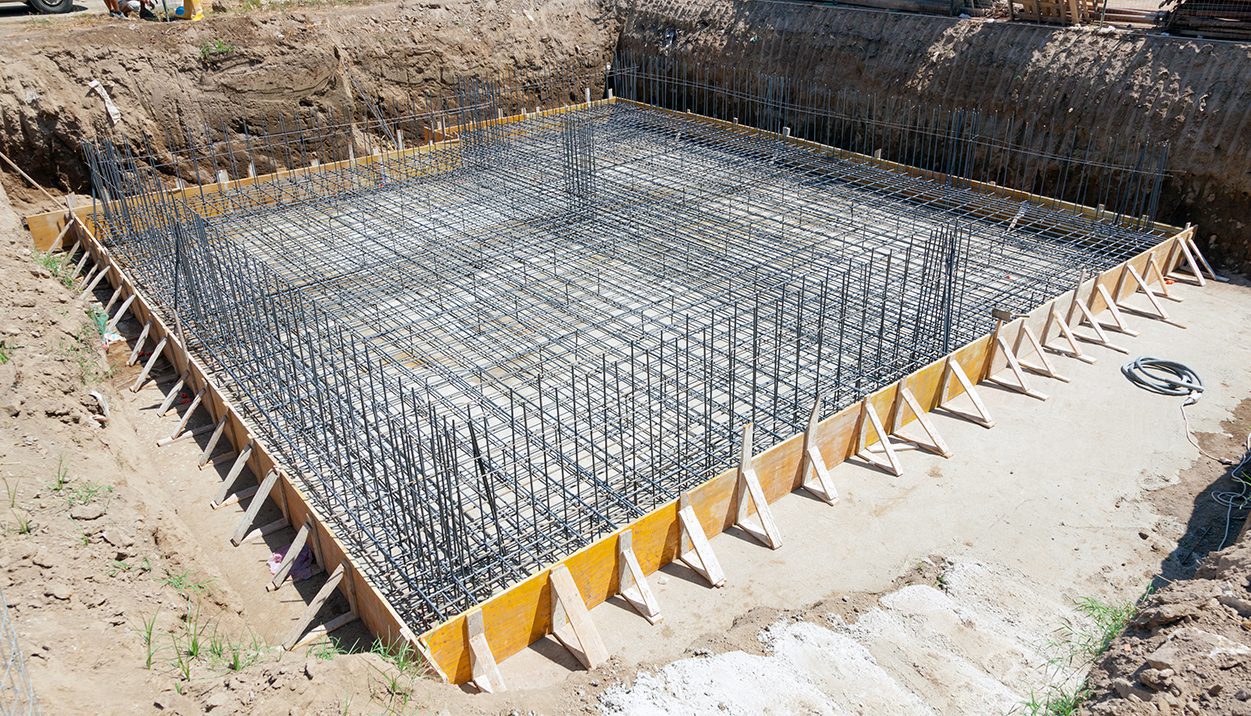
















In this post, we aim to highlight the importance of foundation design as one of the most crucial parts of civil construction, being the fundamental basis for keeping the structure intact and safe.
Types of Foundations
Shallow and deep. The choice between a shallow or deep foundation depends on several factors, such as the nature of the soil, the load of the structure, and environmental conditions.
Shallow Foundations
Shoes: These are concrete structures that distribute the load of columns and walls over a larger area of the ground. They are ideal for soils with good bearing capacity and moderate loads.
Foundation slab: This is a reinforced concrete slab that covers the entire area of the building, distributing the load evenly. It is used when the soil has low bearing capacity or when the structure is extensive.
Building Blocks: These are concrete blocks that support isolated pillars, transmitting the loads to the ground in a point-like manner.
Deep Foundations
As andstakes: They are driven or molded into the ground to reach more resistant layers. Consequently, this process ensures greater stability to the structure. It is used when the soil has low bearing capacity or when the structure is extensive.
Caissons: They are an ideal choice for ensuring the necessary stability in constructions that require a more robust foundation.
Coffins: Large-volume structures, usually made of concrete, used in terrains with large variations in depth or in very weak soils.
Importance of Foundations
The project plays several fundamental roles in civil construction:
Load Distribution: They transfer the load of the structure to the ground in a uniform manner, preventing differential settlements that can cause cracks and failures in the building.
Structural Stability: They guarantee the stability of the building against external forces, such as winds, earthquakes and floods.
Durability: A well-executed foundation increases the durability of the building, preventing structural problems over time.
Security: They protect the structure against catastrophic failures, ensuring the safety of the occupants.
Factors considered in Foundation Design
Foundation design requires careful analysis of several factors:
Soil Characteristics: The bearing capacity, compressibility, and water table of the soil are determining factors in choosing the type of foundation.
Structure Load: The weight of the building, including permanent and variable loads, directly influences the design of the foundations.
Environmental Conditions: The presence of groundwater, the possibility of erosion, and other environmental factors must be considered to avoid future problems.
Cost and Timeframe: The choice of foundations must balance the execution costs and the time available for construction.
Conclusion
The appropriate choice between shallow and deep foundations should be based on a detailed analysis of the soil characteristics, the loads the structure will support, and the prevailing environmental conditions. With varying types, each offers specific solutions for different engineering challenges.