

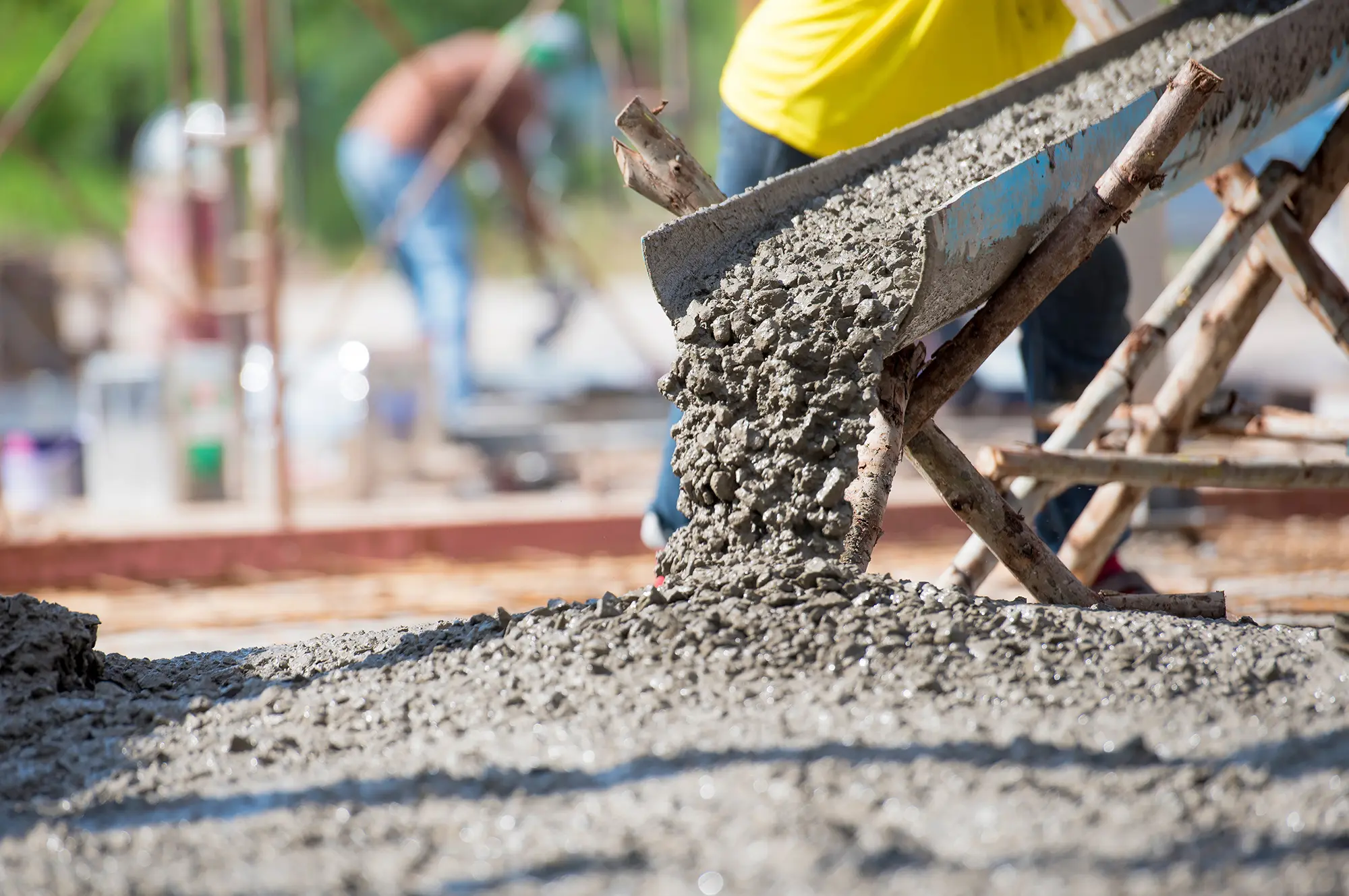
















The choice between ready-mix concrete and concrete produced on-site directly influences the quality, cost, timeline, and structural safety of the project. More than just comparing unit prices, this decision involves mechanical performance, durability, and technical risk throughout the structure's lifespan. Therefore, the responsible engineer must evaluate this choice carefully and responsibly.
Throughout this guide, the text presents the practical and regulatory differences between the two solutions, allowing for an informed and technically sound decision.
What is ready-mix concrete?
Ready-mix concrete, also called central-mixed concrete, is produced in specialized plants that operate with automated processes and rigorous quality control. In this system, the plant doses cement, aggregates, water, and additives by mass, which reduces variations and virtually eliminates human error.
After mixing, concrete mixer trucks transport the concrete to the construction site, keeping the material in continuous rotation. This way, the concrete doesn't begin to set before application. Thus, the team receives the material ready for use, according to the project specifications.
In general, the process begins with defining the mix design and compressive strength (fck), continues with automated dosing, proceeds to mixing in a controlled environment, and ends with immediate application to the structure. As a result, the construction receives a homogeneous and predictable concrete.
What is concrete on a construction site?
In contrast, on-site concrete is produced directly at the construction site. In this model, the team assumes full responsibility for the mix design, dosage, and mixing. Typically, workers measure the materials manually and mix them using a conventional concrete mixer.
Furthermore, the final quality depends heavily on the experience of the workforce, water control, and environmental conditions. For this reason, the absence of technical supervision significantly increases the risk of variations between batches.
In practice, the team calculates the mix design, stores the materials, measures each component, mixes the concrete, transports it internally, and then applies the material. Because the workability time is limited, any delay can compromise the final performance.
Fundamental Technical Differences
Quality Control and Homogeneity
In ready-mix concrete, production takes place in a controlled industrial environment, with precise dosage and consistent batch standards. Furthermore, the plant conducts frequent laboratory tests, ensuring traceability and compliance with technical standards.
On the other hand, in concrete mixed on-site, manual dosing increases the probability of error. As a consequence, variations in proportion, inconsistencies between batches, and a lack of formal technological control arise. In practice, this reduces the structural predictability of the work.
Strength and Durability
When ready-mixed concrete is used in construction, the material more reliably meets the characteristic strength defined in the project. In this way, the concrete gains strength predictably, which reduces the occurrence of cracks and pathologies over time.
In contrast, concrete produced on-site exhibits variable final strength. Small deviations in the water-cement ratio directly compromise the compressive strength (fck). Therefore, the durability of the structure becomes heavily dependent on the execution and supervision adopted.
Deadline and Productivity
From a scheduling perspective, ready-mix concrete allows for fast and continuous pouring. This reduces cold joints and increases daily productivity. As a direct result, formwork removal occurs sooner.
In the case of on-site concrete, preparation takes longer. Furthermore, interruptions during mixing become frequent, increasing the risk of delays and compromising the uniformity of the structural elements.
Cost Comparison
In terms of direct cost, ready-mix concrete has a higher unit value. However, when losses, rework, and durability are considered, the overall cost becomes more balanced, especially for medium and large volumes.
In on-site concrete work, the initial cost is usually lower. However, material waste, higher labor costs, and future corrections can increase the final cost of the project.
Advantages and Limitations
Ready-mix concrete stands out for its controlled quality, guaranteed strength, fast execution, less waste, and greater structural safety. On the other hand, this system requires efficient logistics, has a higher initial cost, and offers less flexibility for small volumes.
On-site concrete mixing offers initial cost savings and flexibility in smaller volumes. However, this method presents inconsistent quality, a higher risk of error, slower execution, and a lack of traceability.
When to Choose Each Solution
Ready-mix concrete is better suited to projects with large volumes, major structures, tight deadlines, and the need for rigorous technological control. On the other hand, on-site concrete is suitable for small projects, non-critical structures, regions without a nearby plant, and situations with extremely limited budgets.
Applicable Technical Standards
Both solutions must comply with NBR 12655, which defines criteria for the preparation, control, and acceptance of concrete. In the case of ready-mixed concrete, NBR 7212 complements the requirements related to production, transportation, and delivery.
Regardless of the concrete's origin, the responsible technician must control the water-cement ratio, mold test specimens, and ensure proper curing.
Conclusion
There is no single solution for all projects. The right choice depends on the volume, structural criticality, timeline, budget, and acceptable risk level. Even so, for most modern structures, ready-mix concrete offers greater predictability, safety, and performance over time.
On the other hand, on-site concrete remains viable in specific applications, provided the team performs the work with technical responsibility. A well-informed decision at this stage reduces future problems, increases the structure's durability, and protects the project investment.