

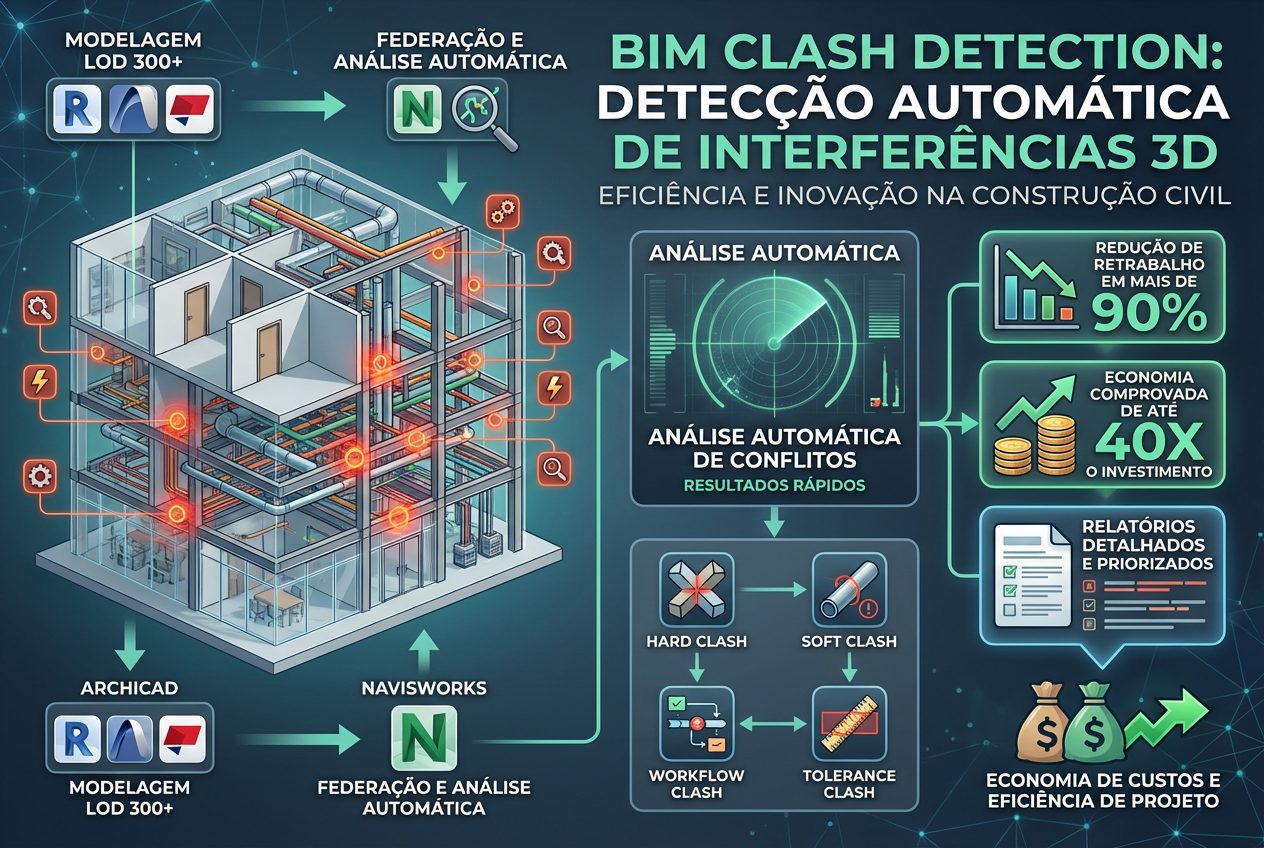
BIM Clash Detection is a automated process which identifies geometric conflicts between elements from different disciplines, such as architecture, structure, and MEP, directly in the 3D model. That way, This eliminates costly and recurring rework during the construction phase.
In practice, each interference identified during the design phase costs only minutes to correct. On the other hand, When the same problem is discovered during execution, it can generate... thousands of reais in additional costs, in addition to days of work stoppage. Furthermore, Statistics indicate that between 60% and 80% of compatibility issues They arise precisely from conflicts that go undetected in the traditional design process.
Like this, This comprehensive guide will demonstrate how to implement Clash Detection professionally in Navisworks, What are the main types of interference, how does the resolution process work, and, most importantly, what proven cost savings are generated?.
What is Clash Detection? Technical Definition
Clash Detection is a automated BIM tool which compares the 3D geometry of multiple disciplines and systematically identifies physical overlaps or violations of minimum spacing between elements.
Differently Unlike traditional manual review—which relies on visually overlaying plans in AutoCAD—Clash Detection analyzes millions of 3D points simultaneously, in a few seconds. Consequently, The process no longer depends solely on the designer's visual experience, since the software ensures... full coverage of the model.
Types of Clash (Interference)
- Hard ClashActual physical overlap, like a pipe passing through a beam.
- Soft ClashViolation of minimum clearance, for example, a pipe 2 cm from the beam when the rule requires 5 cm.
- Workflow ClashConflict in construction sequence, such as masonry planned before the structure.
- Tolerance ClashDimensional deviation outside the permitted tolerance, even if small.
Workflow: 5 Disciplines → Navisworks → Reports
Step 1: Modeling LOD 300+ by Discipline
Initially, each discipline should model with constructive precision, adopting LOD 300 or higher:
| Discipline | Software | Critical Elements |
|---|---|---|
| Architecture | Revit | Walls, doors, slabs, ceilings |
| Structure | Revit | Pillars, beams, structural slabs |
| Hydraulics | Revit MEP | PVC pipes, sewers, boxes |
| Electric | Revit MEP | Electrical conduits, trays, panels |
| Air conditioning | Revit MEP | Ducts, grates, FCUs |
In this context, The essential requirement is precise geometry, with a maximum error of less than 1 cm.
Step 2: Model Federation in Navisworks
Next, all models are imported simultaneously:
Navisworks Project (.nwf) ├── Arquitetura.rvt ├── Estrutura.rvt ├── Hidraulica.rvt ├── Eletrica.rvt └── Ar-Condicionado.rvt
In this process:
- First, all files are selected.
.rvt - Next, Navisworks performs automatic federation.
- Finally, the scale and origin are found to be coincident.
Step 3: Setting up Clash Rules
Afterwards, Navisworks allows you to define specific rules by discipline, ensuring greater control.
For example:
Rule 1: Structure vs. Plumbing - Tolerance: 5 cm minimum - Type: Hard + Soft Clash Rule 2: Electrical vs. Air Conditioning - Tolerance: 3 cm minimum - Type: Hard Clash Rule 3: Architecture vs. All - Tolerance: 2 cm - Exceptions: doors and windows may overlap walls
Step 4: Running Clash Detection
After configuration, execute the command: Clash Detective → New Test → Run Test.
From this, The process occurs completely automatically.
- Initially, the software compares 100% of the elements.
- Next, it identifies all violations of the rules.
- Next, it generates reports with 3D images.
- Finally, it classifies each clash by severity.
On average, The execution time varies between 5 and 30 minutes for buildings of approximately 10,000 m².
Step 5: Reporting and Coordination
As a result, each clash generates a detailed report:
CLASH #147 - CRITICAL Element 1: Beam V-045 (Structure) Element 2: Pipe CVK-23 (Hydraulics) Location: Floor 5, Sector B Overlap: 15 cm Responsible: Structural Engineer + Hydraulic Engineer Resolution time: 48h
Most Common Types of Interference
1. Hydraulic Piping vs. Structural Beams (45%)
Generally, this is the most common conflict, usually involving pipes running through main beams.
In that case, The most commonly adopted solutions are:
- Raise the pipe by 20 cm.
- Cut the beam locally (average cost: R$ 5,000)
- Completely redesign the hydraulic layout.
2. Electrical Conduits vs. Air Conditioning Ducts (25%)
Secondly, conflicts arise between electrical trays and main ducts.
Like this, The most common solution is to move the vertical trays by about 30 cm.
3. Doors and Windows vs. Pillars (15%)
In this scenario, the structural area is encroached upon by window and door frames.
Therefore, The correction involves moving the window frame back or adjusting the column section.
4. Ceilings vs. Installations (10%)
Here, the problem arises when the ceiling is too close to the grilles or ducts.
Consequently, Level adjustments become necessary.
5. Others (5%)
This includes stairs, elevators, shafts, and technical boxes.
Resolution Process: 4D Weekly Meetings
In addition, A weekly coordination meeting is held, lasting approximately 1 hour.
Typical schedule:
- First, the already resolved clashes are reviewed.
- Next, the new conflicts are presented in 3D.
- Next, those responsible are defined.
- Then, deadlines are established.
- Finally, the next retest is scheduled.
Resolution Cycle
Week 1: 147 clashes detected ↓ Week 2: 89 clashes remaining (40% resolved) ↓ Week 3: 23 clashes remaining (85% resolved) ↓ Week 4: 3 minor clashes (98% resolved) ↓ FINAL APPROVAL FOR WORK
In practice, It takes 3 to 4 cycles to resolve between 95% and 99% of the conflicts.
Conclusion
In short, Clash Detection transforms the compatibility of a process. manual, fallible and costly in a flow automated, reliable and highly efficient.
Therefore, Companies that correctly adopt this methodology reduce rework by more than... 90%, with a relatively low investment. Like this, each R$ 1 invested returns between R$ 30 and R$ 40 in proven economics, making Clash Detection mandatory in more complex projects.