











Do you know which drain is best suited for your bathroom? Generally, this component only receives attention when a problem arises. In this context, Water seepage, bad smells, or even sewage backflow can appear unexpectedly.
In practice, However, choosing the right drain is just as important as the piping itself. That's because, When the drain is inadequate, the entire bathroom drainage system is compromised. As a consequence, Excessive moisture, mold, and even structural damage can occur, which in turn often lead to high repair costs.
Throughout this article, Here, you will learn about the main types of drains available on the market. Furthermore, You will understand in which situations each one should be used. In the same way, You will learn how to properly size and identify which solution offers the best cost-benefit ratio. In this way, By the end of this reading, you will have the technical confidence to specify the correct drain for your project.
What is a bathroom drain?
The drain is the device responsible for collecting water from the floor and directing it to the sewer pipes. I.e, It acts as the link between the wet environment and the building's drainage system.
Although it seems simple, Its function is critical. In the end, A well-designed drain prevents flooding and, at the same time, prevents the return of sewer gases. Consequently, It contributes directly to the durability of the environment.
For this to happen, Every drain must meet three fundamental requirements.
- Efficient drainage, guaranteeing, Thus, the water drains quickly.
- Health safety, preventing, Therefore, the return of gases and odors.
- Durability, ensuring, Therefore, it is resistant to continuous use.
If any of these requirements fail, Problems arise quickly. Like this, However, accumulated water, persistent odors, and even backflow through the floor may occur.
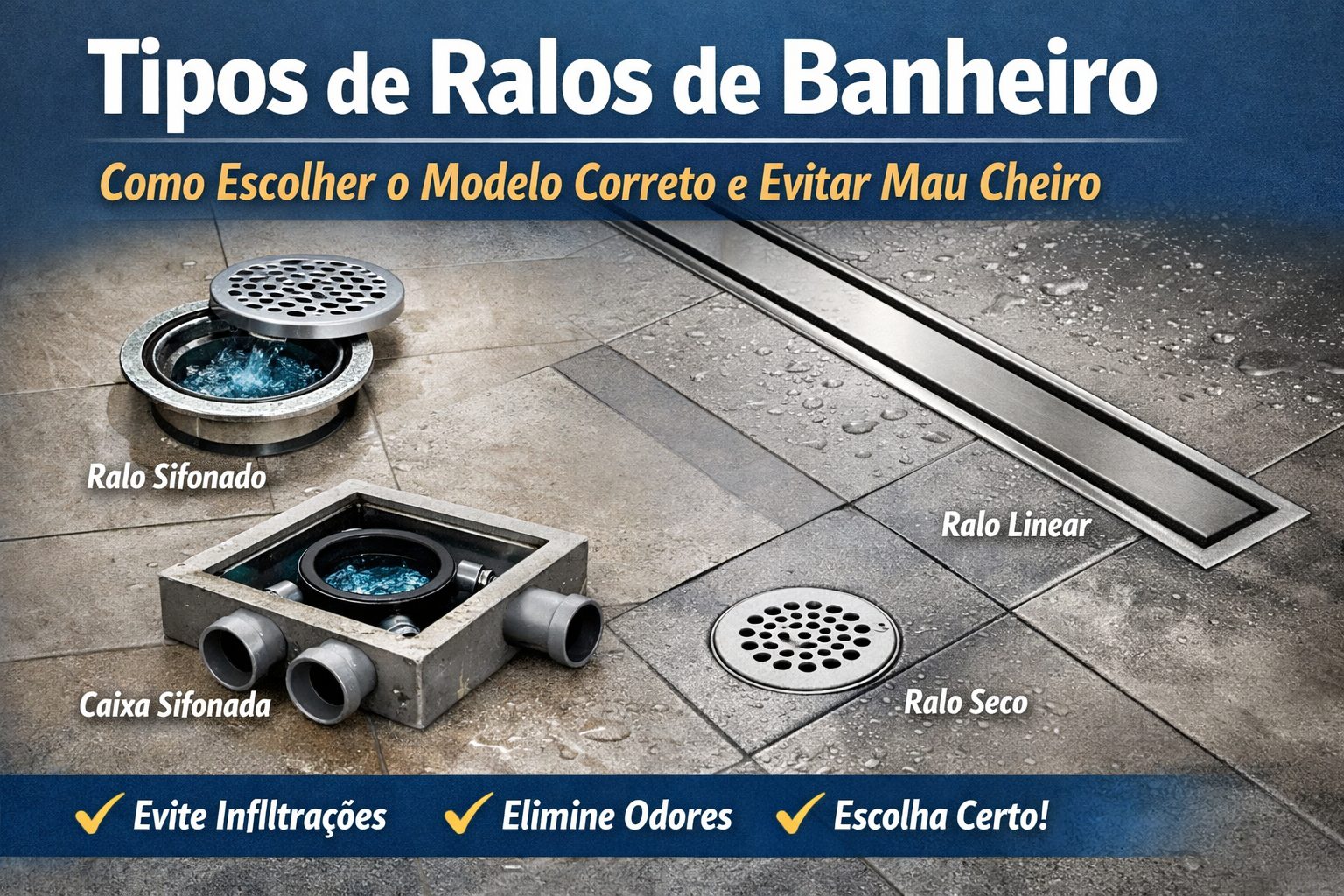
Dry Drain
The dry drain is the simplest and oldest model. Basically, It functions like a funnel connected directly to the sewer pipes.
Main Features
It has only one grate for retaining larger debris.
Furthermore, it has neither a siphon nor a water seal.
Consequently, its connection is directly to the piping.
Finally, it offers quick and easy installation.
Advantages
First of all, it has a very low cost, typically between R$ 15 and R$ 40.
Furthermore, its installation is simple.
Similarly, cleaning is made easier.
Consequently, there is no water retention.
Disadvantages
However, it allows sewer gases to return.
In addition, it frequently generates a bad smell.
Similarly, it does not offer adequate sanitary safety.
Finally, it does not meet current technical standards.
When to Use
Currently, the use of dry drains is not recommended in new constructions that comply with NBR 15.575. Consequently, It only appears in emergency renovations or in very old buildings.
Installation Cost
Cost of the drain around R$ 20.
Furthermore, the labor costs vary between R$ 50 and R$ 100.
Therefore, the total cost is between R$ 70 and R$ 120.
Siphoned Drain
The siphon drain is currently the safest solution for modern bathrooms. This happens because It uses an internal siphon that retains water permanently. That way, A barrier against gases is created.
Main Features
It has a chamber with a water seal.
In addition, it features a grill and a removable basket.
Similarly, it features a protected connection to the sewer pipe.
Consequently, the internal slope prevents reflux.
Advantages
First, it blocks gases and odors from the sewer.
Furthermore, it offers proven sanitary safety.
Similarly, it makes periodic cleaning easier.
Consequently, it fully complies with technical standards.
Finally, it works well in different layouts.
Disadvantages
On the other hand, it has a higher cost, generally between R$ 80 and R$ 250.
In addition, it can dry out if left unused for extended periods.
However, it still requires basic periodic maintenance.
When to Use
In general, a siphon drain is mandatory in modern residential bathrooms and apartments. Furthermore, it is essential in projects that follow NBR 15.575. In the same way, It is highly recommended for locations with a history of bad odor.
Linear Drain
The linear drain, in turn, replaces the central point with a continuous line. For this reason, It is widely used in contemporary projects.
Main Features
Elongated shape, ranging from 30 centimeters to 2 meters.
Furthermore, drainage occurs along the entire length.
Consequently, the look becomes cleaner and more modern.
It is generally made of stainless steel.
Finally, it usually has an integrated siphon.
Advantages
First and foremost, it provides fast and even drainage.
Furthermore, it offers a high aesthetic standard.
Similarly, it performs excellently on large floors.
Consequently, it makes cleaning the area easier.
Finally, it becomes discreet in its finish.
Disadvantages
However, it has a high cost, ranging from R$ 300 to R$ 1,200.
Furthermore, the installation is more complex.
Similarly, it requires a precise slope of the floor.
Consequently, maintenance is more specialized.
Siphon Box
The siphon box acts as an intermediary element. I.e, It receives water from various points before directing it to the main pipeline.
Main Features
A box embedded in the floor, usually measuring 30 by 30 centimeters.
In addition, it accommodates multiple pipe inlets.
Similarly, it has an internal siphon.
Consequently, it features a removable cover for maintenance.
Finally, it is installed in a strategic location within the environment.
Advantages
First, it centralizes drainage.
In addition, it protects multiple points with a single siphon.
Similarly, it facilitates inspection and cleaning.
Consequently, it is widely used in larger projects.
Disadvantages
However, it takes up floor space.
Furthermore, it requires greater intervention in the project.
If it becomes clogged, it consequently affects several points.
Finally, maintenance tends to be more complex.
Conclusion
In short, choosing the right drain is a fundamental technical decision. Therefore, It directly impacts the comfort, sanitary safety, and durability of the bathroom.
Objectively speaking.
Modern homes should preferably use a siphon drain.
Buildings, in turn, require a siphoned drain with adequate ventilation.
High-end bathrooms, consequently, benefit from linear drains.
Commercial areas, ultimately, demand centralized solutions.
Therefore, the cost of specifying correctly during the design phase is minimal when compared to the losses caused by leaks, odors, and rework.
WGB Engenharia specializes in the specification, sizing, and complete compatibility of water and sanitation systems. That way, It ensures performance, regulatory compliance, and durability over time.