
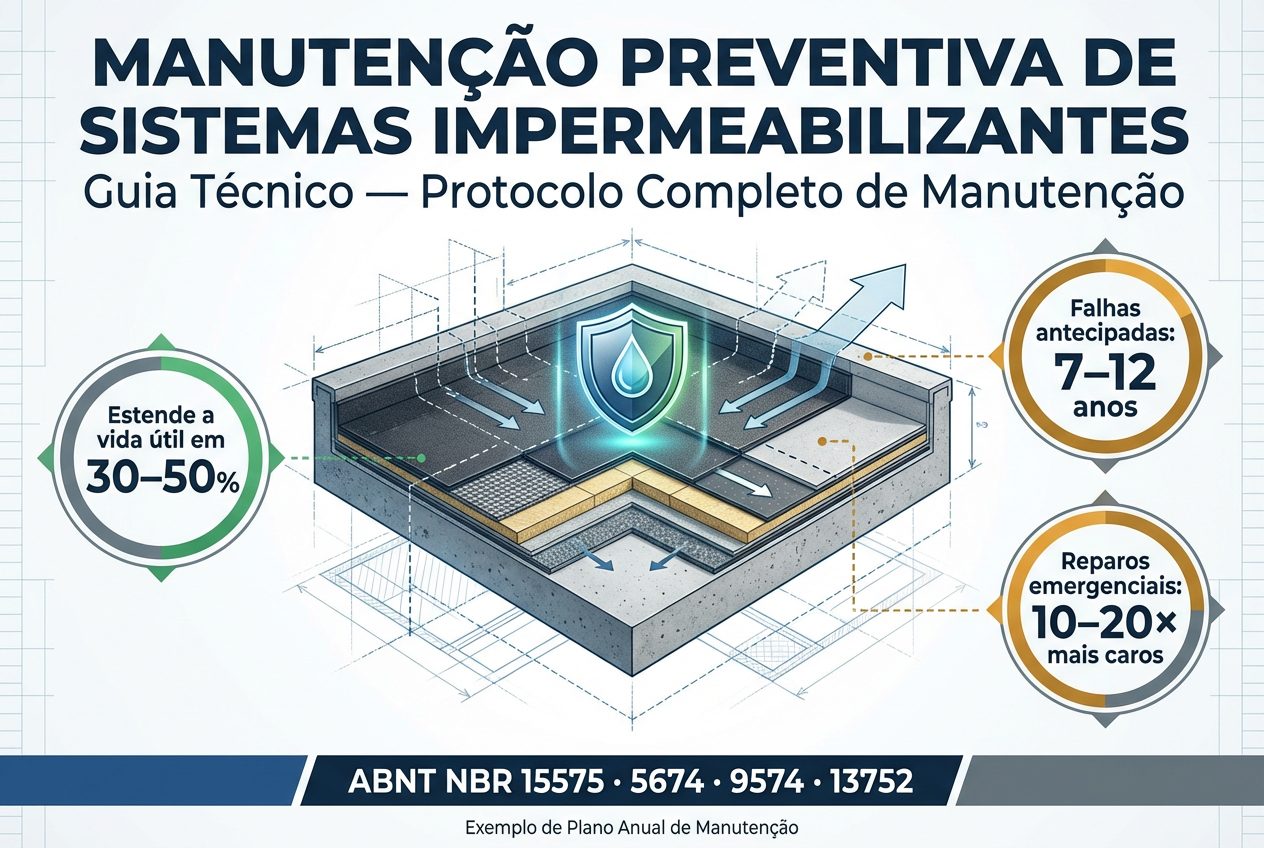
First and foremost, preventive maintenance of waterproofing systems must be understood as a strategic investment and not as an operational cost. When applied continuously and in a planned manner, This practice is capable of extending the lifespan of systems in 30 to 50%. On the other hand, The absence of maintenance anticipates failures between 7 and 12 years old, which inevitably leads to emergency repairs with costs up to 10 to 20 times superior.
Furthermore, when comparing a well-maintained waterproofing system with superior performance to... 25 years, due to neglected waterproofing, which fails to 8 to 10 years, The difference between is clearly noticeable. preserved heritage e permanently degraded structure.
Therefore, adopting systematic protocols for inspection, cleaning, and spot repairs becomes a technical requirement, and not just a good practice.
Thus, this technical guide presents, in a structured manner, the complete preventive maintenance protocol, including a comparison with corrective maintenance, recommended inspection levels, appropriate cleaning procedures, objective intervention criteria, and finally, a Practical example of an annual maintenance plan..
Preventive Maintenance vs. Corrective Maintenance
Preventive Maintenance (Essential Approach)
Initially, preventive maintenance can be defined as the set of planned periodic actions, carried out before the emergence of faults, focusing on inspection, cleaning, maintenance and localized adjustments.
In this context, its main objectives are:
- Firstly, identify anomalies at an early stage
- Right away, correct minor damage before it worsens
- Furthermore, monitor the natural wear and tear of materials
- Consequently, extend the system's lifespan
- Finally, reduce the total cost of ownership by up to 80–90%
Regarding frequency, it is recommended:
- Monthly, Quick visual inspections, especially after heavy rain.
- Every six months, thorough cleaning combined with a detailed assessment
- Annually, Professional technical inspection with formal report.
- Every 5 to 10 years, comprehensive reassessment of the waterproofing system
Corrective Maintenance (Reactive Approach)
In contrast, corrective maintenance occurs only after the failure, That is, when leaks, stains, cracks, or peeling have already appeared.
In this scenario, several critical problems arise. Firstly, the costs are significantly higher, ranging between 5 and 10 times preventive maintenance. Furthermore, However, prolonged exposure to moisture compromises structural elements. Added to that, However, urgency reduces quality control during execution, which negatively impacts future durability.
From a financial point of view, the difference is clear:
Preventive maintenance
- Average annual cost: R$ 5 to 10/m²
- Cumulative cost over 25 years: R$ 125 to 250/m²
- Result: System integrity for up to 25 years.
Corrective maintenance
- Emergency repairs: R$ 100 to 300/m²
- Repeated interventions every 3 to 5 years
- Cumulative cost over 25 years: R$ 500 to 1,500/m²
- Result: a continuous cycle of failures and repairs.
➡ Therefore, preventive maintenance provides direct savings of between 75 and 80%.
Periodic Inspection Protocol – Four Levels
Level 1 – Monthly Post-Rain Inspection (Visual)
First, the monthly inspection consists of a quick and predominantly visual check, lasting on average... 20 to 30 minutes. Even though simple, This step is crucial to prevent the silent progression of failures.
Externally (roofs):
- First, check for the presence of standing water.
- Next, check for loose tiles, slabs, or membranes.
- In addition, check gutters and downspouts.
- Similarly, inspect flashing and wall junctions.
- Finally, assess apparent structural movements.
Internally (ceilings and walls):
- Identify new moisture stains.
- Check for recent mold growth.
- Assess plaster detachment
- Detect characteristic odors of water infiltration.
If any evidence is identified, then It should be documented with photos and a higher-level inspection should be scheduled.
Level 2 – Semiannual Inspection (Cleaning and Evaluation)
Subsequently, the semi-annual inspection, preferably carried out in the spring and autumn, combines complete cleaning with detailed technical assessment.
Main steps:
- Deep cleaning
- Initially, manual removal of leaves and debris.
- Next, gently clean gutters and drains.
- Subsequently, remove moss and algae with a diluted solution.
- Waterproofing assessment
- Asphalt membranes: bubbles, cracks or detachments
- Liquid membranes: cracking or loss of elasticity
- Sealants and joints: drying out or cracking
- Drainage assessment
- Tilt check
- Inspection of drain operation
- Identification of puddle points
- Photo documentation
- Record with scale, location and date.
Level 3 – Annual Professional Inspection
In addition to routine inspections, an annual technical inspection conducted by a qualified professional is mandatory.
Typically, the following are used:
- Thermal imaging camera
- Thermo-hygrometer
- Crack gauge
- Non-destructive testing
As a result, a report is prepared containing:
- Complete technical diagnosis
- Plant with anomaly mapping
- Risk classification
- Budget estimate for interventions
➡ Average cost: R$ 5 to 15/m²
➡ Potential return: savings between R$ 50 thousand and R$ 500 thousand
Level 4 – Full Reassessment (5 to 10 Years)
Finally, a complete reassessment allows for strategic decisions:
- Up to 50% service life: regular preventive maintenance
- Between 60 and 80%: intensification of inspections
- Above 80%: system re-execution planning
Low-Cost Maintenance Procedures
Gutter Cleaning
- Frequency: monthly to quarterly
- Average cost: R$ 500 to 2,000
Sealing of superficial cracks (< 2 mm)
- Use of elastomeric sealants
- Minimum cure time of 24 to 48 hours.
- Larger cracks require technical evaluation.
Mold Removal
- Cleaning with diluted solution
- Never paint over active mold.
- Recurrence indicates actual infiltration.
Example of an Annual Maintenance Plan
Commercial building – 5,000 m² of rooftop space
- Annual professional inspection: R$ 15,000
- Two deep cleanings: R$ 20,000
- Minor repairs: R$ 25,000
- Monitoring and documentation: R$ 10.000
Total annual cost: R$ 70,000 (R$ 14/m²)
Consequently, The savings compared to corrective maintenance outweigh... 80%.
Applicable Technical Standards
- ABNT NBR 15575 Performance and lifespan
- ABNT NBR 5674 – Building maintenance
- ABNT NBR 9574 – Waterproofing installation
- ABNT NBR 13752 – Inspections and technical assessments
Conclusion
In summary, preventive maintenance it does not represent a cost, but rather a technical strategy for heritage preservation.
While well-maintained systems achieve 25 to 30 years of performance, Neglected systems enter continuous cycles of failures and repairs.
Therefore, adopting periodic inspections, scheduled cleanings, and targeted interventions generates returns among... 50 and 100 times the invested value, In addition to preserving the structure, ensuring safety and maintaining the real estate value of the building.